
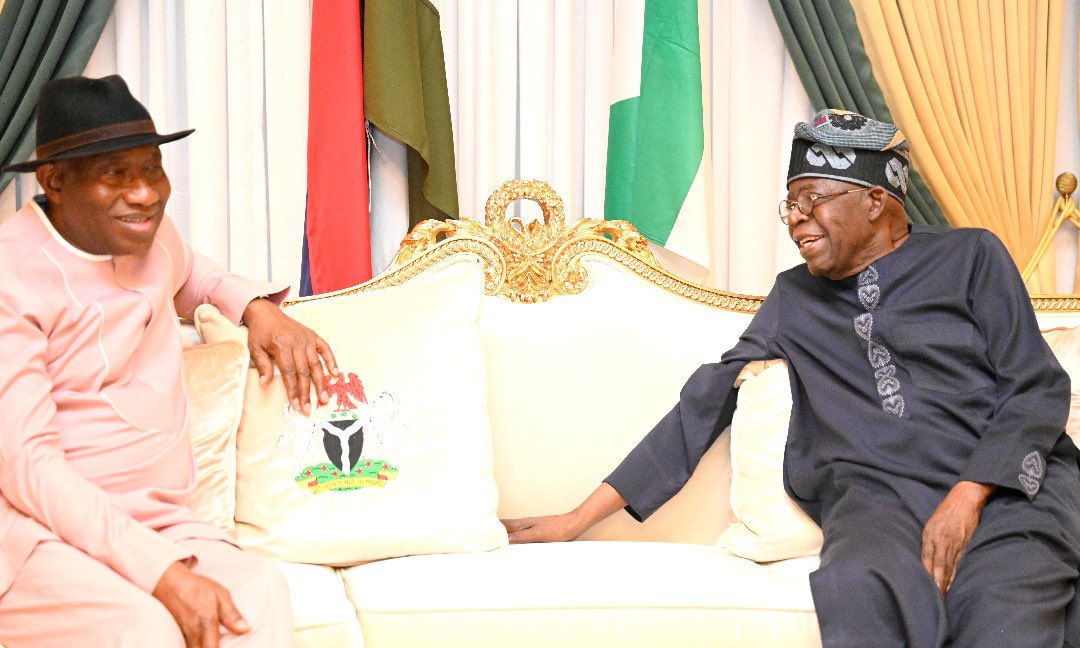
President Bola Ahmed Tinubu received former President Goodluck Ebele Jonathan at the Presidential Villa on Saturday following Jonathan’s return from an election-monitoring mission in Guinea-Bissau.
Jonathan had travelled to the West African nation as part of a joint observer mission by the African Union (AU), the Economic Community of West African States (ECOWAS) and the West African Elders Forum (WAEF) to monitor Guinea-Bissau’s presidential and legislative elections.
His mission in Bissau was abruptly derailed when the military announced a takeover just days before election results were due. Observers described the action as a “coup” — a serious disruption of the democratic process — and locked down borders, imposed curfews and suspended electoral activities. Regional actors including ECOWAS and the AU condemned the takeover, declaring it a violation of shared democratic principles and demanding the release of detained political figures and election officials.
As unrest grew and concerns mounted for the safety of foreign observers, Nigeria’s Federal Government acted swiftly. The Ministry of Foreign Affairs confirmed that Jonathan had been evacuated on a special flight along with members of his delegation, and that he had safely departed Guinea-Bissau. A delegation comprising former presidents and heads of various observer missions condemned the takeover as a deliberate attempt to derail the electoral process.
Upon his return, Jonathan met with President Tinubu at the presidential residence to brief him on developments. The meeting underscored Abuja’s concern over the deterioration of democratic norms in the region and highlighted Nigeria’s commitment to the protection of its citizens abroad — especially those engaged in diplomatic, regional or humanitarian work.
The crisis in Guinea-Bissau comes amid a broader resurgence of military coups and political instability across parts of West Africa, raising fresh alarm over the fragility of democratic institutions in the region. Nigeria’s response — both in facilitating Jonathan’s evacuation and in condemning the unconstitutional takeover — signals a readiness to defend constitutional governance abroad and safeguard the welfare of its citizens involved in regional diplomacy and election observation.
The return of Jonathan marks the end of what had been a tense episode, offering a measure of reassurance that despite the breakdown of order in Bissau, Nigerian officials abroad remain under the protective reach of their government.

