
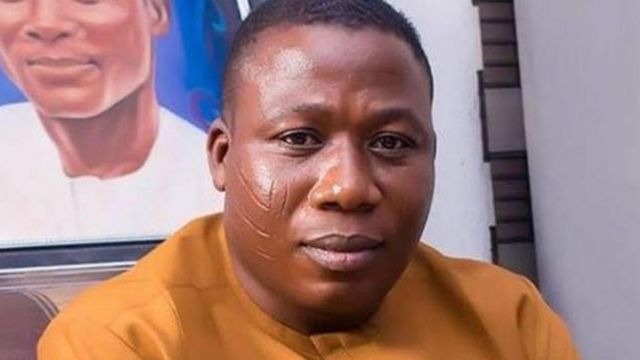
Yoruba nation activist, Chief Sunday Adeyemo, popularly known as Sunday Igboho, has commended President Bola Tinubu, South West governors and traditional rulers across Yorubaland following his return to Nigeria after nearly five years in exile.
Igboho returned to the country last Monday after years outside Nigeria, a development that attracted widespread public attention. He had gone into exile after the administration of the late President Muhammadu Buhari declared him wanted over allegations of stockpiling arms and ammunition.
On July 1, 2021, operatives of the Department of State Services, supported by military personnel, raided his residence in Ibadan, Oyo State, in an attempt to arrest him. The operation resulted in the death of two of his aides, while 13 others were arrested.
In a statement issued after his return, Igboho expressed deep appreciation to President Tinubu, whom he credited with granting him a pardon that paved the way for his return to the country. He described the decision as a significant act of mercy and leadership.
“I deeply appreciate the mercy and maganimity of our revered President Bola Tinubu, who graciously granted me freedom to return to Nigeria after intervention by stakeholders in the traditional institution,” he said.
He stated that he would not take the opportunity for granted and pledged his readiness to support national efforts at addressing insecurity and promoting development, particularly in the South West.
“While I would not take this opportunity and freedom for granted, I am ready to collaborate with the Federal Government in tackling the ravaging insecurity and support measures aimed at enhancing peace and socioeconomic growth in the country, especially in the South West.”
Igboho also expressed gratitude to the governors of the South West states for what he described as their critical support, naming Seyi Makinde of Oyo State, Dapo Abiodun of Ogun State, Babajide Sanwo-Olu of Lagos State, Ademola Adeleke of Osun State, Biodun Oyebanji of Ekiti State, and Lucky Aiyedatiwa of Ondo State.
“It is also very germane to appreciate all the South West State governors, namely Seyi Makinde (Oyo), Dapo Abiodun (Ogun), Babajide Sanwo-Olu (Lagos), Ademola Adeleke (Osun), Biodun Oyebanji (Ekiti), and Lucky Aiyedatiwa (Ondo), for their critical support and enviable roles,” he said.
While commending the governors, Igboho singled out Governor Makinde for special praise, citing what he described as visible developmental strides across Oyo State.
“While commending the South West governors, I want to single out Governor Seyi Makinde for his giant strides in the steady development of Oyo State. The visible impacts of his administration in virtually all the sectors and enviable infrastructural growth of this state have greatly turned around the aesthetics of Oyo to the envy of all.”
He also congratulated Makinde on the celebration of Oyo State’s 50th anniversary, noting that the event highlighted the contributions of past leaders and statesmen to the state’s development.
“Similarly, I want to congratulate him on the commemoration of the 50th anniversary of Oyo State, which showcased noble roles played by statesmen and past leaders, whose significant contributions laid a stronger pedestal for the healthy developments being witnessed today.”
Igboho further acknowledged the role of traditional rulers across Yorubaland, describing their intervention as critical to his freedom and return to Nigeria.
“But my gratitude over the current freedom which I savour would be ineffectual without recognising the timely intervention of all Yoruba monarchs.”
He gave special recognition to prominent monarchs, including the Olubadan of Ibadan, Oba Rashidi Adewolu Ladoja, the Ooni of Ife, Oba Enitan Adeyeye Ogunwusi, and the Olugbon of Orile Igbon, Oba Francis Olushola Alao, among others.
“Special recognition goes to the Olubadan of Ibadan, Oba Rashidi Adewolu Ladoja, Ooni of Ife, Oba Enitan Adeyeye Ogunwusi, Olugbon of Orile Igbon, Oba Francis Olushola Alao, and other monarchs too numerous to mention.”
Igboho also expressed appreciation to Yoruba indigenes for their support and solidarity during his years in exile, reaffirming his commitment to peace and unity.
“Besides, the love and support from all Yoruba indigenes are too massive, and I will continue to cherish everyone while also recommitting myself to the peace, unity, growth, and protection of the collective interest of our ethnic nationality.”

