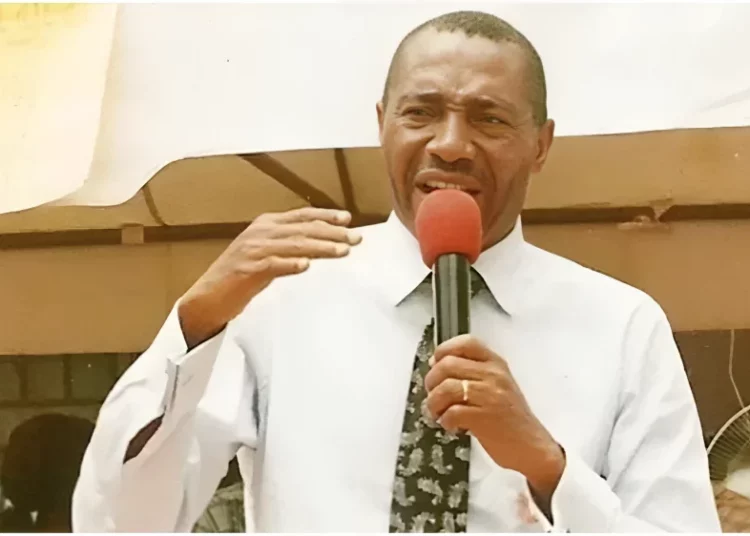
A former member of the National Assembly, Senator Ikechukwu Obiorah, has called for a constitutional amendment to strip the President and State Governors of their power to appoint the Chairman of the Independent National Electoral Commission (INEC) and state-level electoral officers.
Senator Obiorah, who represented Anambra South Senatorial District from 2007 to 2011, made this proposal in a treatise titled “The Philosophy of Elections and Nigeria’s Fake Democracy,” which was disseminated to journalists in Abuja. He argued that the fundamental lack of honest and transparent elections is the root cause of mass poverty and underdevelopment in Nigeria.
The former lawmaker asserted that a vast majority of elections in Nigeria’s history have been compromised. “Since Independence, 90 percent of all elections… have been brazenly stolen or rigged or perverted or altogether thwarted or nullified,” Obiorah stated. He attributed this directly to the conflict of interest inherent in the current system, where those who appoint the electoral bodies are also contestants in the elections, describing it as “making a person a judge in his own case.”
He highlighted that this power was vested in the Prime Minister and later the President since independence, and with the 1999 Constitution, extended to State Governors for appointing State Independent Electoral Commissions (SIECs). This, he noted, has led to non-competitive local government elections and widespread disputes in other polls.
While acknowledging the role of technology, Obiorah cautioned that systems like the Bimodal Voter Accreditation System (BVAS) and the INEC Results Viewing Portal (IReV) are vulnerable to manipulation without a neutral and independent electoral body to manage them.
As a solution, Senator Obiorah has drafted a bill, which has been sent to both chambers of the National Assembly, proposing the establishment of a new, truly independent INEC. His model for the commission’s composition is as follows:
* The new INEC would be composed of thirteen commissioners.
* Six commissioners would be elected by six Nigerian professional and labour organizations, with each organization electing one member from a specific geopolitical zone:
* Academic Staff Union of Polytechnics (North Central)
* Academic Staff Union of Universities (North East)
* Institute of Chartered Accountants (North West)
* Nigerian Bar Association (South East)
* Nigerian Medical Association (South South)
* Nigerian Union of Journalists (South West)
* Six commissioners would be nominated by the United Nations (UN).
* One commissioner-observer would be nominated by Transparency International.
Obiorah clarified that involving international bodies would not violate Nigeria’s sovereignty, as it would be a voluntary request from Nigeria. He cited the precedent of Honduras, where the government recently requested UN assistance in establishing an anti-corruption commission. He also specified that the UN and Transparency International would not nominate Nigerian citizens.
Under his proposal, the President would collate the names and forward them to the National Assembly for confirmation. A nominee could only be rejected by a concurrent resolution supported by a two-thirds majority of both houses, conducted via a secret, televised ballot. The tenure for a commissioner would be a single term of four years, and the new INEC would have the power to elect its own Chairman and manage its staff.
Obiorah concluded that this reform is essential to break the cycle of electoral malpractice and would not be a setback to the devolution of powers to the states.