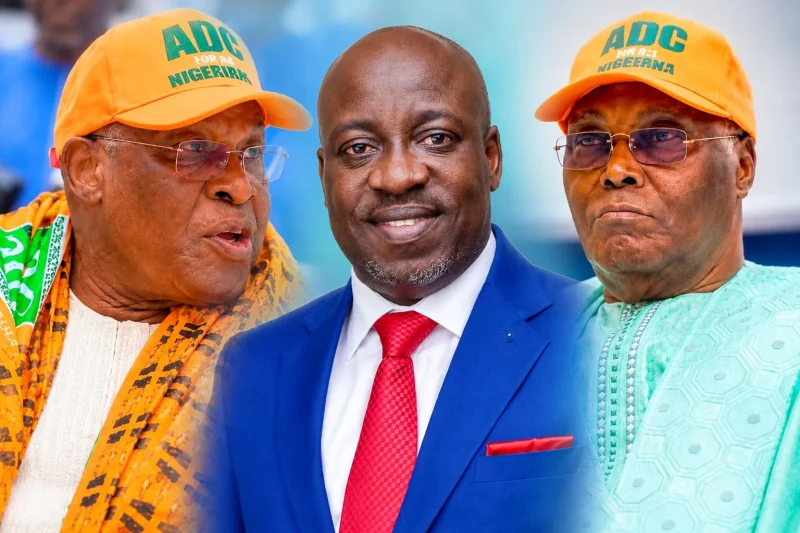
Former Vice President Alhaji Atiku Abubakar has unleashed a fierce condemnation of the Economic and Financial Crimes Commission’s (EFCC) detention of former Sokoto State Governor Senator Aminu Waziri Tambuwal, branding it a blatant extension of President Bola Tinubu’s aggressive strategy to harass, intimidate, and dismantle opposition forces ahead of the 2027 general elections.
In a bold statement issued personally on Tuesday, August 12, 2025, Atiku vowed that the opposition coalition would stand unyielding against what he described as the ruling All Progressives Congress’s (APC) insidious push to forge a one-party dictatorship in Nigeria.
Atiku asserted that Tambuwal’s arrest stems directly from his affiliation with the opposition coalition, framing it as part of a broader pattern under the Tinubu administration to weaponize anti-corruption efforts as a political bludgeon. “It is a continuation of the Tinubu-led administration’s agenda to harass, intimidate, and decimate the opposition,” he declared, accusing the government of transforming the fight against corruption into a tool for coercing rivals into the APC fold. He lamented that once opposition figures align with the ruling party, their alleged transgressions are swiftly overlooked, a tactic he said undermines institutional integrity.
“We are living witnesses to a growing trend where the state and its operators have assumed the roles of a bully by making corruption and the fight against it a political agenda,” Atiku continued, reflecting on his own role in establishing the EFCC during his tenure as Vice President under Olusegun Obasanjo. He stressed that the agency’s original purpose was to combat graft impartially, not to serve as a political instrument. “Certainly, that is not the objective for which I worked hard during our administration to create the EFCC. It is as though today, anyone who associates with the opposition is a target for phantom corruption allegations and, it is as though, as soon as they are coerced into the political agenda of President Bola Tinubu, their ‘sins’ are forgiven.”
Atiku warned that such practices fuel corruption rather than curb it, providing “the stimulant for corruption to thrive.” He highlighted a series of recent incidents where the EFCC has allegedly pressured opposition state governors to defect to the APC, suggesting that the agency’s actions are far from isolated. “We have seen how the EFCC has been used to empty opposition state governors into the ruling party, and the tea party is not about to end anytime soon,” he remarked, calling for condemnation from civil society and international partners.
Reaffirming the opposition’s resilience, Atiku assured Nigerians that the coalition would resist these “anti-democratic machinations” aimed at imposing a one-party state. “Our assurance to Nigerians is that we would never succumb to these anti-democratic machinations of railroading our people into a one-party dictatorship,” he concluded, positioning the opposition as a bulwark against authoritarian tendencies.
This episode echoes longstanding accusations of political weaponization of anti-corruption agencies in Nigeria. During the 2015 elections, former President Goodluck Jonathan faced similar claims when the EFCC targeted APC figures, only for the tables to turn under Muhammadu Buhari’s administration, where PDP members were aggressively pursued. In 2023, amid pre-election tensions, the EFCC’s raids on opposition strongholds sparked widespread protests, with critics alleging a ploy to suppress votes. The 2024 detention of a prominent PDP senator on embezzlement charges, later dropped after his defection to the APC, further fueled suspicions of selective justice. Atiku’s stance amplifies these concerns, highlighting a pattern that threatens Nigeria’s democratic fabric as the 2027 polls loom.