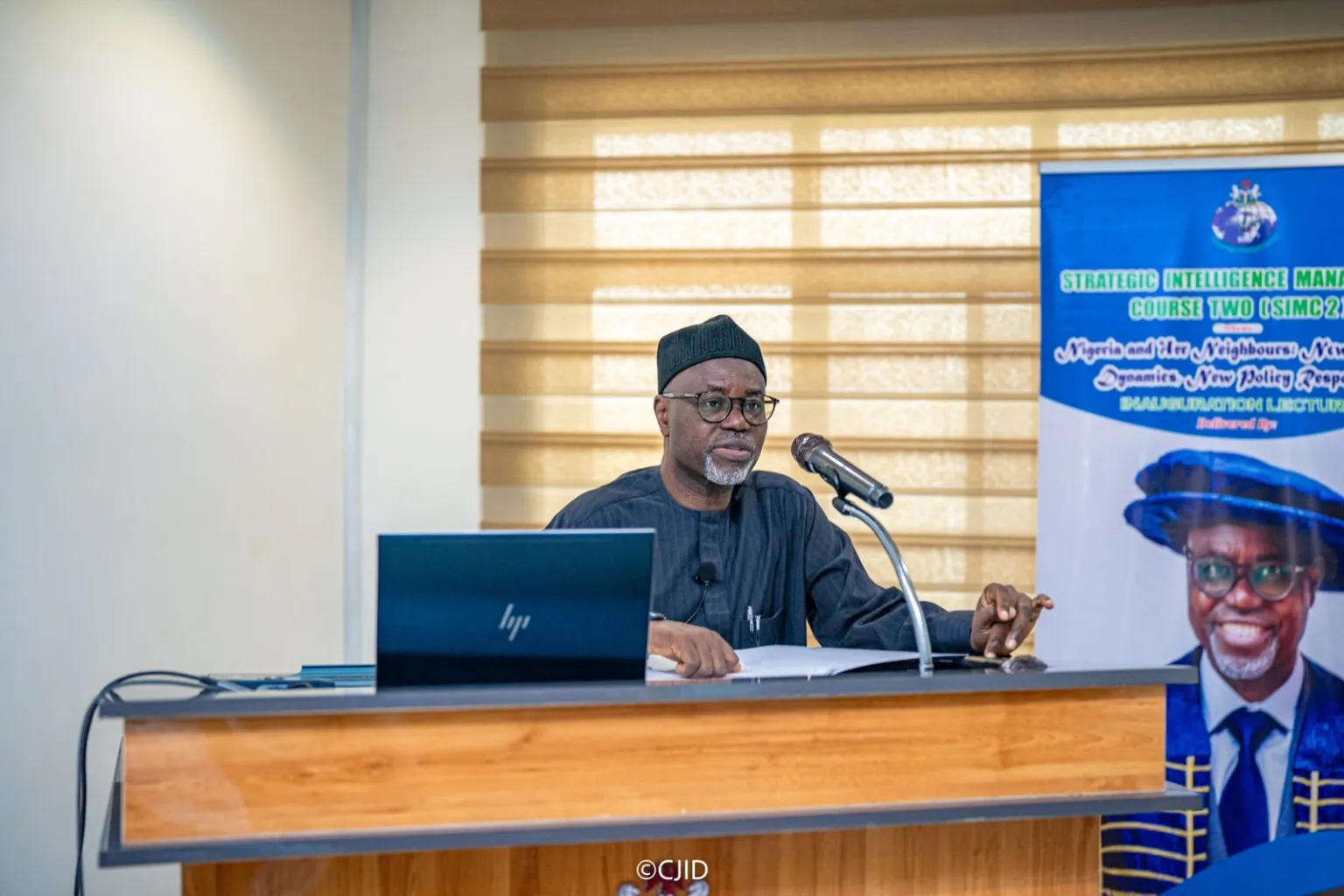
The Vice Chancellor of the University of Ilorin, Wahab Egbewole, has proposed a series of diplomatic, security and economic measures aimed at reshaping Nigeria’s engagement with neighbouring countries amid growing instability across West and Central Africa.
Egbewole, a professor of jurisprudence and international law, made the recommendations on Wednesday while delivering the inaugural lecture at the Strategic Intelligence Management Course Two hosted by the Strategic Intelligence Management Institute.
The lecture, themed “Nigeria and Her Neighbours: New Regional Dynamics, New Policy Responses,” focused on the changing security landscape in the sub-region and the implications for Nigeria’s national security and foreign policy.
According to the vice chancellor, the issue of shifting regional dynamics goes beyond academic debate and has become a critical national security concern.
“This is an existential intelligence concern and an urgent diplomatic call to duty,” he said.
Egbewole noted that between 2020 and 2023, West and Central Africa witnessed eight successful coups in countries including Mali, Guinea, Burkina Faso, Niger and Gabon, significantly altering regional political stability.
He also referenced an attempted coup in the Benin in December 2025, which he said was suppressed due to Nigeria’s swift military intervention.
According to him, every coup within Nigeria’s neighbourhood creates direct and indirect security consequences for the country.
“The governance vacuum created brings immediate spill-over effects, frustrates the war against terrorism, throws up unpredictable actors into bilateral relationships, and creates conditions that violent jihadist groups and other criminal elements exploit to extend their operational reach,” he said.
He warned that the growing “coup belt” across the region represents not only a governance challenge but also a direct national security threat gradually pushing instability toward Nigeria’s borders.
On the diplomatic front, Egbewole proposed the appointment of senior Neighbourhood Policy Envoys, the establishment of a Nigeria Neighbourhood Security Council and the appointment of a Special Envoy to re-engage with the Alliance of Sahel States formed by Mali, Niger and Burkina Faso following their exit from the Economic Community of West African States.
He also urged Nigeria to champion a new ECOWAS Security Protocol capable of addressing emerging regional threats.
As part of a revamped security framework, the professor advocated the development of a Nigerian Neighbourhood Defence Doctrine and the full operationalisation of the ECOWAS Standby Force.
Other recommendations included the establishment of a Nigeria-Benin-Ghana Coastal Security Corridor, the reinvigoration of the Multinational Joint Task Force in the Lake Chad Basin and the full operationalisation of the Yaoundé maritime security architecture.
On economic cooperation, Egbewole proposed a development-focused regional partnership model that treats economic growth as a security imperative.
His recommendations included the creation of a Nigeria Neighbourhood Development Fund, mobilisation of the ECOWAS Business Council and full implementation of the African Continental Free Trade Area.
The vice chancellor also called for stronger intelligence collaboration across the region through sustained investment in the West Africa Intelligence Fusion Centre, direct bilateral intelligence-sharing agreements and digitalisation of Nigeria’s border management infrastructure.
He further recommended the establishment of a dedicated counter-disinformation unit within the National Intelligence Agency, warning that disinformation campaigns, climate disruption and displacement-related conflicts were increasingly destabilising the region.
Egbewole also advocated increased funding for Nigeria’s Technical Aid Corps, stronger integration of academic research into policymaking and the promotion of cross-border community engagement programmes.
To ensure implementation of the proposals, he called for the establishment of a Neighbourhood Policy Execution Unit within the Presidency, the development of a Five-Year Nigeria Neighbourhood Strategy Document and dedicated budgetary allocations for neighbourhood policy implementation.
“Nigeria must urgently arise not by mere rhetoric, but through dedicated budget releases, specialised diplomatic appointments, intelligence investments, scholarship programmes, and community engagement initiatives,” he said.
“Nigeria can no longer handle its neighbourhood from a comfortable multilateral distance. It must engage bilaterally, continuously, intelligently, and with genuine strategic empathy for the human realities of each of its neighbours.”
Earlier at the event, the Provost of the Strategic Intelligence Management Institute, Jadesola Adesuyi, commended Egbewole for facilitating the partnership between the institute and the University of Ilorin.
“We have the good fortune of Professor Egbewole’s depth of knowledge as a scholar, legal luminary and administrator to help navigate these deep waters and chart a course towards cogent policy options,” she said.