
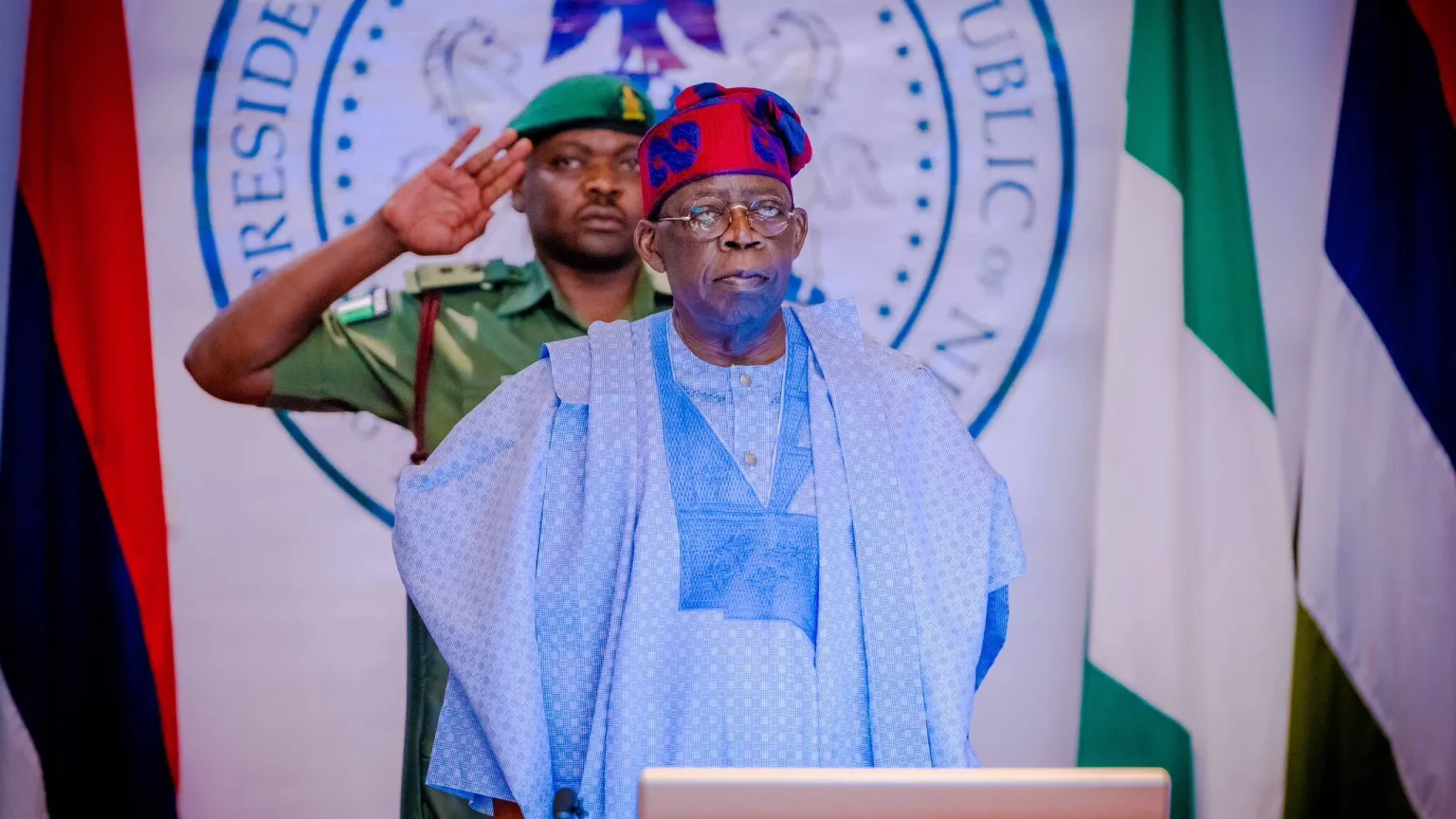
President Bola Tinubu on Friday, December 19, presented the 2026 Appropriation Bill of N58.18 trillion to a joint session of the National Assembly.
During the presentation, the President described the budget as the “Budget of Consolidation, Renewed Resilience and Shared Prosperity.” He stated that it is the culmination of two-and-a-half years of “painful but necessary” reforms aimed at steering Nigeria towards macro-economic stability, job-rich growth, and inclusive prosperity.
Key highlights of the 2026 appropriation bill include total revenue of N34.33 trillion and total expenditure of N58.18 trillion, with N15.52 trillion allocated for debt servicing. Recurrent non-debt expenditure is set at N15.25 trillion, capital expenditure at N26.08 trillion, and the deficit at N23.85 trillion, representing 4.28 per cent of GDP.
The President said the budget is anchored on four pillars: consolidating macro-economic stability, improving the business and investment climate, promoting job-rich growth and poverty reduction, and strengthening human capital while protecting vulnerable groups. Sectoral allocations include Defence and Security, N5.41 trillion; Infrastructure, N3.56 trillion; Education, N3.52 trillion; and Health, N2.48 trillion.
President Tinubu emphasised that security remains the bedrock of development, noting that the N5.41 trillion allocation will support modernising the armed forces, enhancing intelligence-driven policing, and securing the nation’s borders. He highlighted that the Nigerian Education Loan Fund has supported over 418,000 students across 229 tertiary institutions, while health spending accounts for six per cent of the total budget net of liabilities.
He observed encouraging signs of stabilisation, with GDP growth rising to 3.98 per cent in the third quarter of 2025 from 3.86 per cent in the same period in 2024. Inflation fell to 14.45 per cent in November from 24.23 per cent in March, and external reserves reached a seven-year high of approximately 47 billion dollars.
To sustain these gains, the budget targets a crude oil benchmark of 64.85 dollars per barrel, production of 1.84 million barrels per day, and an exchange rate of N1,400 to the US dollar for 2026. President Tinubu stressed the need for discipline in budget execution, directing ministries, departments, and agencies (MDAs) to adhere strictly to appropriated timelines and implement end-to-end digitisation of revenue mobilisation to curb leakages.
He also called for enhanced revenue mobilisation through new National Tax Acts and reforms in the oil and gas sector, alongside stringent performance targets for government-owned enterprises. The President noted that the budget introduces a new national counter-terrorism doctrine, reclassifying bandits, militias, armed gangs, and other non-state armed groups as terrorists.
“The doctrine mandates unified command, intelligence-sharing and community-based peace building to combat violence that threatens national survival,” he said.
President Tinubu urged unity between the executive and legislature to deliver the full promise of his administration’s Renewed Hope Agenda, reiterating that the 2026 budget is not merely a list of numbers but a statement of national priorities.

