
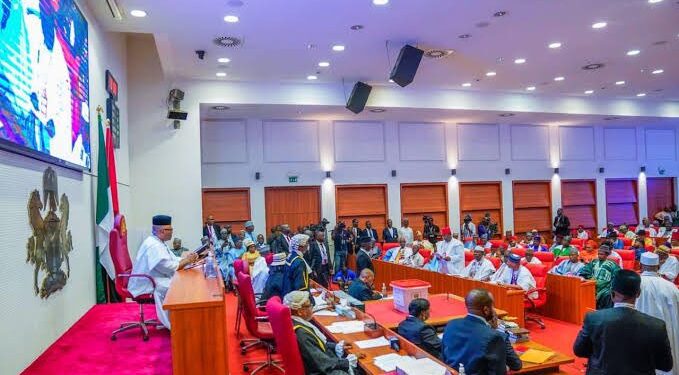
The Senate Committee on Downstream Petroleum Sector has pledged to resolve the ongoing jurisdictional conflict between the Nigeria Midstream and Downstream Petroleum Regulatory Authority (NMDPRA) and the Oil and Gas Free Zone Authority (OGFZA).
Chairman of the committee, Senator Abdulrahman Sumaila, made the commitment at the end of a five-day retreat organised by the committee in Yenagoa, Bayelsa State.
Sumaila said the committee would develop practical and implementable recommendations aimed at promoting regulatory harmony, restoring investors’ confidence, strengthening energy security and supporting sustainable economic growth.
He explained that the retreat provided a neutral platform for stakeholders in the petroleum sector to engage and address concerns arising from overlapping statutory responsibilities between government agencies.
“The objectives of the retreat are to facilitate meaningful dialogue among all stakeholders on issues arising from the overlapping statutory mandates; develop practical coordination framework capable of promoting seamless regulations, while respecting the lawful mandates of the institutions involved.
“The committee will also examine whether legislative clarification or amendment is required, study and identify ambiguities as well as to ensure that the outcomes of the retreat are in line with national security, consumer protection, market stability and economic growth,” he said.
Sumaila assured participants that the committee would carefully review all presentations, submissions and legal arguments made during the retreat before reaching its recommendations.
He said the outcome of the deliberations would be based on evidence and aimed at providing both immediate and long-term solutions to the regulatory disagreements affecting the sector.
“Where permanent legislation, policy or constitutional reforms are required to prevent conflicts among the agencies, the committee will not hesitate to recommend such measures in the override interest of the nation.
“Our ultimate goal is to establish a regulatory environment characterized by regularities, cooperation, accountability, efficiency and legal certainty; one that supports engagement, promotes healthy institutional collaboration, safeguard national interest and strengthens Nigeria’s position as leading energy hub in Africa,” he added.
The Managing Director of the Oil and Gas Free Zone Authority, Alhaji Bamanga Jada, urged regulatory agencies in the petroleum industry to avoid actions that encourage uncertainty and overlapping responsibilities among government institutions.
Jada said all agencies operating within the sector should work towards creating a business-friendly environment through stronger regulatory cooperation and adherence to the rule of law.
“This should be done relying on the global principles of the rules of law, with concerted efforts to continue building and sustaining investors’ confidence,” he said.
He stressed that for Nigeria to achieve its ambition of becoming Africa’s leading energy and industrial hub, investors operating in free zones must be allowed to benefit from coordinated regulatory systems similar to those adopted globally.
“If Nigeria is to become Africa’s foremost energy and industrial hub, Free zone investors like Dangote Industries Free Zone must be allowed to enjoy the one-stop-shop principle which is being practiced in all successful Free Zones across the globe.
“They all operate one coordinated regulatory system, and all institutions of government in Nigeria must continue to be encouraged to understand the greater national objectives of the Free zone scheme,” Jada said.
The dispute between regulatory bodies in the petroleum sector has centred on overlapping mandates and the need for clearer coordination under Nigeria’s evolving oil and gas regulatory framework following reforms introduced by the Petroleum Industry Act.

