
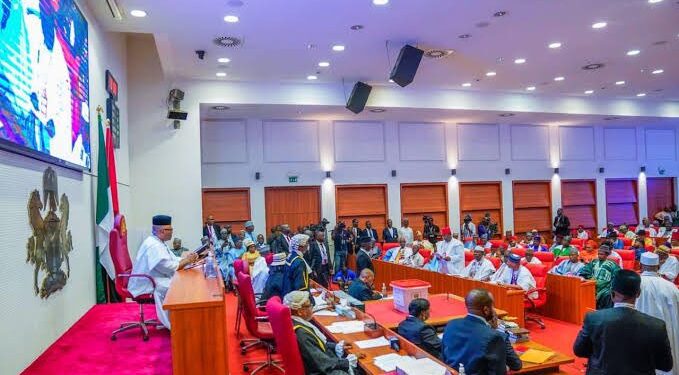
The Senate on Wednesday passed for second reading a bill seeking to establish a legal framework for the regulation, coordination, transparency and disclosure of foreign aid, grants and donations received in Nigeria.
The proposed legislation, sponsored by Senator Ibrahim Dankwambo (PDP, Gombe North), is titled A Bill for an Act to Provide for the Regulation, Coordination, Transparency, and Disclosure of Foreign Aid, Grants, and Donations in the Federal Republic of Nigeria, 2026 (SB. 1034).
Leading the debate, Dankwambo said the bill is designed to strengthen accountability and improve the coordination of foreign assistance in the country, noting that Nigeria remains one of the major recipients of foreign aid through grants, humanitarian support, technical assistance and concessional financing from bilateral and multilateral development partners.
He acknowledged that foreign assistance has supported key sectors such as healthcare, education, agriculture and humanitarian interventions but argued that the current system remains fragmented, poorly coordinated and lacking in transparency.
According to him, donor-funded projects are often implemented across ministries, departments and agencies without adequate coordination, with some executed outside the national budget framework, duplicated across institutions or misaligned with the country’s development priorities.
“This weak coordination undermines efficiency, reduces value for money, and, in some cases, erodes public trust,” he said.
Dankwambo explained that the bill is anchored on Sections 80 to 83 of the 1999 Constitution, which vest control of public funds in the National Assembly and empower the Auditor-General of the Federation to audit public accounts.
He argued that once foreign aid is received and utilised within Nigeria, it becomes a public resource and should therefore be subject to constitutional oversight, transparency and accountability.
The senator also cited the Fiscal Responsibility Act, 2007, which requires prudent management of public resources and integration of revenues and expenditures into a coherent fiscal framework.
He said the proposed legislation seeks to close existing gaps by ensuring that foreign aid is no longer treated as off-budget expenditure or excluded from national accountability mechanisms.
“The problem is not the absence of institutions, but the absence of a binding legal framework that coordinates them,” Dankwambo said.
He noted that while the Federal Ministry of Finance engages development partners, the Budget Office integrates some donor-funded projects, the Debt Management Office oversees concessional loans and the Office of the Accountant-General tracks disbursements, there is currently no statutory framework compelling all stakeholders, including non-governmental organisations and sub-national governments, to harmonise their activities, disclose relevant information and ensure accountability.
According to him, the bill proposes the establishment of a National Donor Coordination Framework anchored on existing government institutions. It also provides for the mandatory registration of foreign aid programmes, the creation of a national database for aid inflows, integration of donor-funded projects into government budgets and alignment of all foreign assistance with national development priorities.
Contributing to the debate, Senator Adams Oshiomhole (APC, Edo North) expressed support for the bill, saying recent international developments have highlighted the need for greater transparency in the use of foreign funds.
“We have seen instances in advanced countries where foreign funds were allegedly provided to certain individuals and groups. This is to pursue activities capable of undermining national unity and creating divisions within societies. We have our own share of such experiences,” he said.
“The truth is that no nation is immune to individuals who are willing to take advantage of external support to pursue interests that may not be in the national interest.
“Therefore, I believe the bill should provide appropriate mechanisms for enforcement and sanctions in cases of non-disclosure.
“We have a responsibility to protect the peace, unity, and stability of our nation, and I do not think any well-meaning Nigerian should object to that.”
Senate President Godswill Akpabio commended Dankwambo for sponsoring the legislation, describing him as well-qualified to champion reforms in the management of foreign aid.
“He is also well versed in the activities and backgrounds of some NGOs. I believe, therefore, that nobody was better suited to bring this kind of bill to the Senate at this time than him,” Akpabio said.
Following the debate, the Senate referred the bill to the Committees on National Planning and Economic Affairs, Finance, and Foreign Affairs for further legislative consideration. The committees are expected to report back to the Senate within six weeks.

