The Ogun State Government has reported a significant achievement in its agricultural sector, generating ₦1 billion in revenue within three months in 2024.
This success is attributed to the state’s rice production initiative, led by Governor Dapo Abiodun, which aims to bolster food security and economic development.
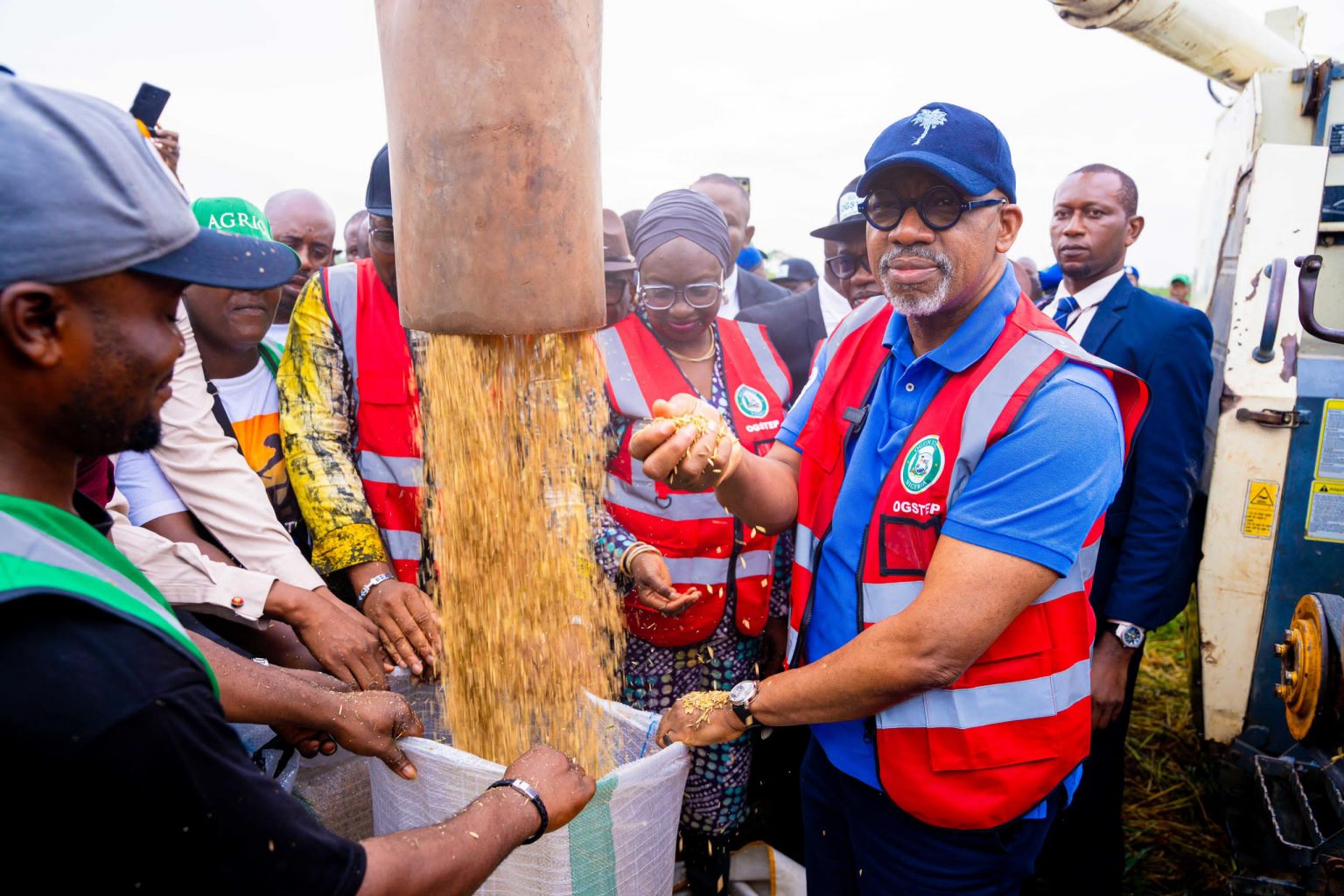
On August 19, Governor Abiodun announced the first major milestone of the project at the Magboro Rice Farm in Obafemi-Owode Local Government Area, where the state government harvested rice planted in May 2024. The pilot project, covering 200 hectares, yielded an impressive 7 metric tons per hectare, resulting in approximately 1,400 metric tons of rice—equivalent to 20,000 bags of milled rice.
This achievement, which has brought in an estimated ₦1 billion in revenue every three months, directly benefits the out-growers, including many youth and women new to farming. Following the successful harvest, the state plans to scale up the project to 2,000 hectares, with future expansions targeting 5,000 hectares. This expansion is expected to generate between ₦10 billion and ₦25 billion in revenue per quarter.
The farm, developed under the Ogun State Economic Transformation Project and supported by the World Bank, is part of Governor Abiodun’s broader strategy to drive economic growth and development in the state.
Speaking at the harvesting event, Governor Abiodun emphasized that Ogun State is now joining other states like Lagos, Kebbi, and Bayelsa in producing locally grown rice, contributing to economic development, job creation, and improved livelihoods within the communities.
“This is a 200-hectare rice farm, where the farmers are predominantly women and youths from various parts of the country. Each farmer was allocated one hectare, meaning we have 200 farmers in this cluster. They began planting in May, and today we are harvesting, making it a three-month cycle. This process can be repeated three times a year,” Governor Abiodun stated.
He added, “With an estimated revenue of ₦1 billion per cycle, these 200 farmers can potentially earn ₦3 billion annually. There is no reason for hunger in Nigeria when initiatives like this are in place.”