
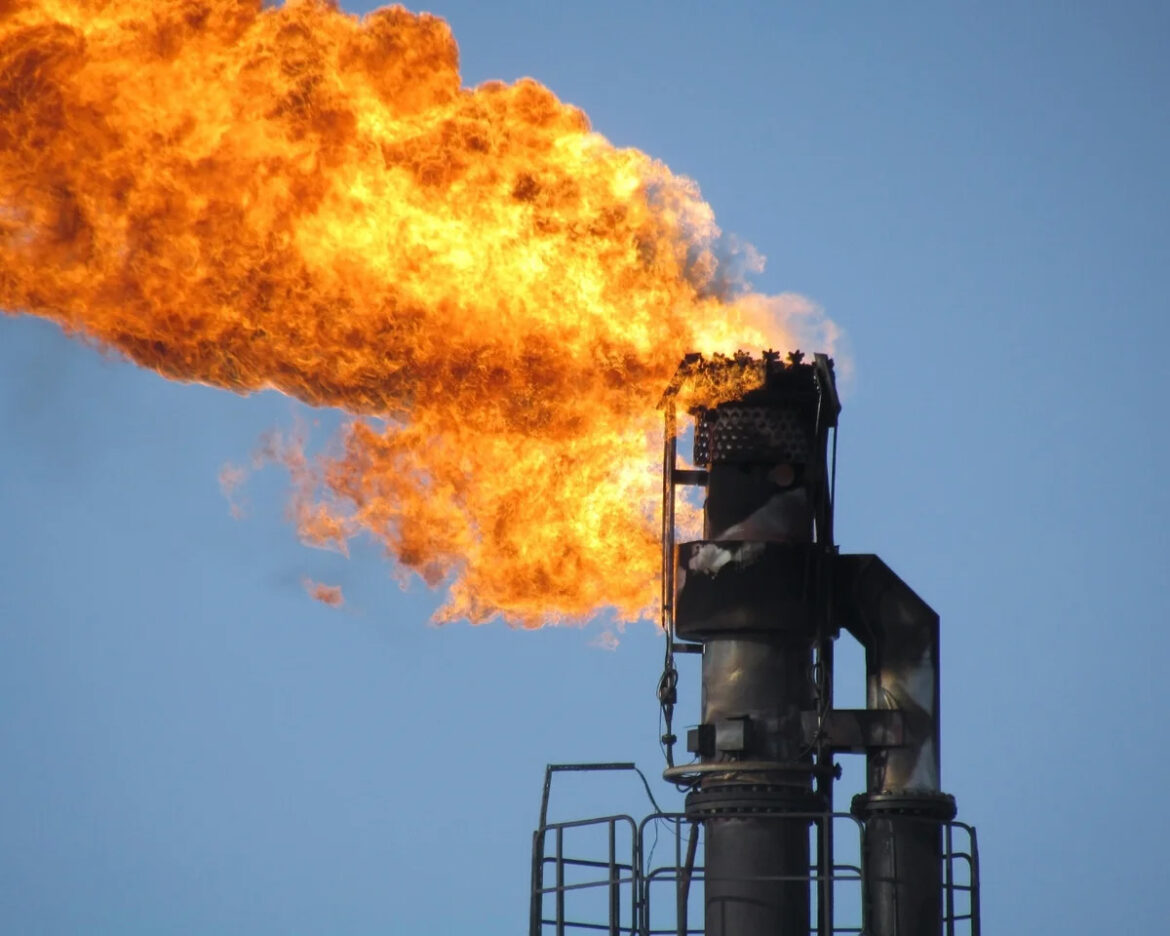
Despite the ambitious climate commitments made by late President Muhammadu Buhari at COP26 in 2021, Nigeria has recorded a 15.7 per cent rise in gas flaring since pledging to achieve net-zero emissions by 2060.
When Buhari declared at COP26 that “Nigeria is committed to net zero by 2060,” the announcement was widely praised as a major step toward aligning the country’s oil- and gas-dependent economy with global climate goals. He stated that “Nigeria will maintain a gas-based energy transition… to attain both development and climate ambitions,” while launching a detailed Energy Transition Plan designed to balance industrial growth with environmental responsibility.
Recent data from the Nigerian Oil Spill Monitor, corroborated by the National Oil Spill Detection and Response Agency, indicates that oil and gas companies flared an estimated 301.1 million standard cubic feet of gas in 2024. Nigeria had previously made progress between 2018 and 2022, cutting flaring from 470.8 million scf to 224.9 million scf, a 52 percent reduction, but 2023 and 2024 recorded a rebound. Flaring rose to 275.5 million scf in 2023 and 301.1 million scf in 2024, representing a cumulative 15.7 per cent increase from the 2021 baseline, the year of the net-zero pledge. Between January and May 2025 alone, 154.1 million scf of gas was flared, marking the highest volume for a five-month period since 2020. “There’s been more (crude oil) production. Production normally comes with flaring,” said Ayodele Oni, partner at Bloomfield Law Practice. “So the more production, the more flare you have, unfortunately.”
The persistence and resurgence of gas flaring remain tied to structural obstacles. According to the Nigerian Upstream Petroleum Regulatory Commission, weak pipeline infrastructure, inadequate gas-processing capacity and limited commercial offtake continue to hinder progress. Economists estimate the cumulative opportunity cost, including lost export earnings, domestic gas supply and potential power generation, at tens of billions of dollars.
Under the Energy Transition Plan, Nigeria committed to eliminating routine flaring by 2030, supported by the Nigerian Gas Flare Commercialisation Programme. The programme was relaunched in 2023 to attract third-party investment aimed at capturing and commercialising associated gas. More recently, the NUPRC reaffirmed this commitment and launched the Upstream Oil & Gas Industry Decarbonisation Blueprint in partnership with the World Bank Group to enhance emissions monitoring and methane abatement. Enorense Amadasu, speaking on behalf of the Commission, noted that “methane emissions account for a significant share of Nigeria’s upstream greenhouse-gas footprint, mainly from flaring, venting, and fugitive sources.” However, the flare-out target remains elusive as recent increases suggest that regulatory measures and commercial frameworks have yet to translate into systemic progress.
Oni said, “The gas commercialisation programmes should be given as much support as it requires. They (government and oil companies) should stand behind that policy and implement it as well as they can.” According to him, the solution lies in supporting the programme “because all these penalties don’t seem to resolve gas flaring. It’s better if we encourage more people to invest in gas flare commercialization.”
In response to rising criticism, authorities have introduced new initiatives aimed at curbing flaring and monetising associated gas. The NUPRC recently announced a collaboration with an Argentinian technology firm to deploy advanced flare-reduction systems. In a statement, the Commission said the partnership would “leverage innovative solutions to convert flared gas into value-added products, creating economic opportunities for the nation.” The National Oil Spill Detection and Response Agency has also reiterated Nigeria’s commitment to ending routine flaring.
Last week, Ekperikpe Ekpo, minister of state for Petroleum Resources (Gas), announced new measures at the Sub-Saharan African Roundtable on Methane Emissions in Abuja. The event, themed ‘Turning Methane Pledges into Action,’ brought together regional stakeholders to discuss strategies for reducing methane pollution. Ekpo said Nigeria is taking decisive steps to meet its national and global commitments on methane reduction and energy transition. He said strict enforcement of flare-out deadlines under the Petroleum Industry Act remains central to these efforts. He added that regulators have been directed to intensify monitoring and ensure operators meet the set timelines for eliminating routine flaring.
To improve monitoring capacity, Ekpo revealed that advanced methane-detection technologies, including satellite systems, drones and handheld sensors, are being deployed to strengthen leak detection and repair across upstream and midstream operations. “These technologies will provide real-time emissions data, enhance accountability, and reduce environmental impact,” he said. He also highlighted new commercial incentives introduced by the Federal Government to support methane abatement, including frameworks for flare-to-power projects, expansion of the LPG market and development of small-scale LNG solutions. According to him, “The incentives are designed to convert previously wasted gas into productive economic value, powering industries, supporting households, and creating employment opportunities.”
Private sector participation is growing, with PE Energy introducing modular gas processing units designed to eliminate flaring at marginal fields. Meanwhile, TotalEnergies reported achieving zero routine flaring at its Nigerian operations seven years ahead of schedule, leveraging its Auséa technology, a drone-based monitoring system that detects and measures methane emissions.

