
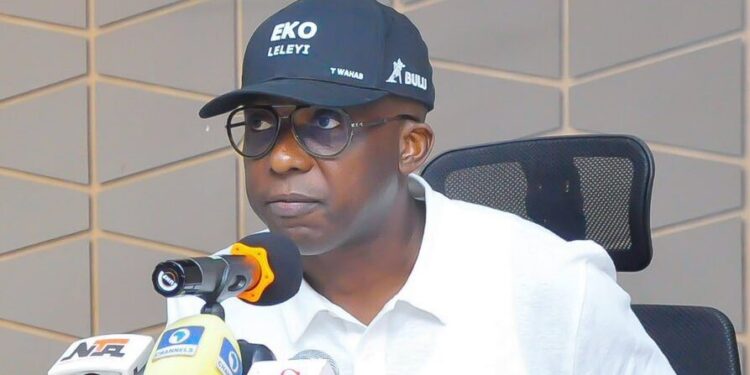
The Lagos State Government has launched a biodigester plant at Ikosi Fruit Market to convert organic market waste into energy and fertilizer as part of efforts to address environmental challenges and promote sustainable waste management.
The disclosure was made by the Lagos State Commissioner for Environment and Water Resources, Tokunbo Wahab, through his official X account on Monday. The project was delivered in partnership with C40 Cities, with support from UK International Development under the Climate Action Implementation programme.
According to the state government, the plant is designed to convert fruit and vegetable waste into biogas for cooking and electricity, as well as fertilizer for farmers. The initiative targets the large volumes of organic waste generated daily within the market.
Wahab stated that the project addresses a long-standing environmental issue in the Ikosi community, noting that the market produces tons of organic waste each day, including fruit peels, vegetable trimmings and unsold produce. He explained that much of the waste previously ended up in drains and dumpsites, contributing to blocked drainage channels, health risks and methane emissions.
“Today, I had the privilege of launching and handing over the Ikosi Fruit Market Biodigester Plant, delivered in partnership with @c40cities and with support from UK International Development under the Climate Action Implementation programme.”
“Every day, Ikosi Fruit Market generates tons of organic waste, fruit peels, vegetable trimmings, unsold produce. In the past, much of this ended up in dumpsites and road medians, clogging drains, creating health risks, and releasing methane into the atmosphere.”
“Today, that same waste will be fed into an anaerobic digester where it will be converted into biogas for cooking and electricity, as well as nutrient-rich biofertilizer for farmers. This is the circular economy in action.”
He added that the initiative aligns with Lagos State’s broader objective of building a resilient and resource-efficient city through community-level climate action.
The launch forms part of Lagos’ wider waste-to-energy strategy, which includes partnerships with foreign firms to manage specialised waste streams and scale up energy recovery. The state entered agreements with Dutch companies Closing the Loop and Harvest Waste Consortium, as well as the Accra-based Jospong Group.
Closing the Loop was tasked with managing electronic waste and planned to establish a local facility to reduce exportation and repurpose materials. In October 2024, Wahab disclosed that Lagos secured a €120 million commitment from the Netherlands to support its project with Harvest Waste Consortium, which is expected to convert between 2,500 and 3,000 tons of municipal solid waste into electricity daily.
In July 2025, the state government also announced plans for a $400 million Waste-to-Energy plant in Epe. The facility is intended to address waste management challenges, supply electricity to two million residents and reduce flooding. The project is planned to be privately operated and is projected to deliver a 12 per cent internal rate of return over 20 years.
Markets such as Ikosi generate substantial volumes of organic waste daily, much of which bypasses formal collection systems. This has contributed to blocked drainage infrastructure, sanitation concerns and environmental pressure within the state.
Data from the state indicates that about 80 per cent of landfill capacity in Lagos was nearly exhausted, while only 63 per cent of households were covered by formal waste collection services. An estimated 67 per cent of households resorted to illegal dumping, with market waste, including food remnants and unsold produce, accounting for a significant share of organic waste volumes.
The Ikosi biodigester project is positioned as a local component of Lagos State’s broader waste-to-energy framework, linking community-level waste reduction efforts with large-scale initiatives such as the planned Epe Waste-to-Energy plant.

