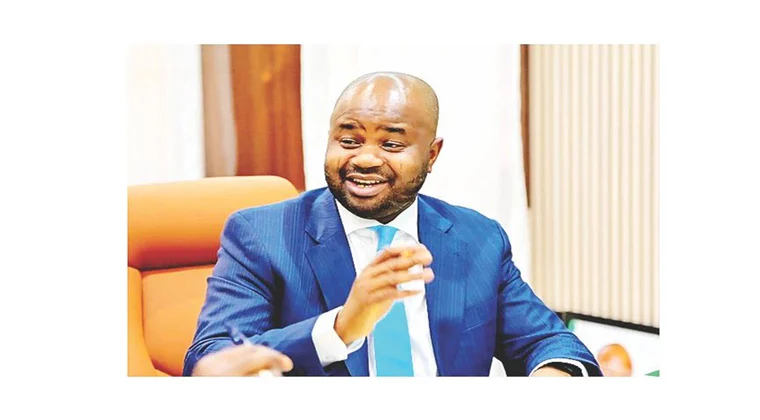
The Executive Chairman of the Nigeria Revenue Service, Dr Zacch Adedeji, has sought to allay public concerns surrounding the newly implemented tax laws, insisting that neither the previous tax regime nor the new framework empowers any authority to tax money held in Nigerians’ bank accounts.
Speaking on Tuesday during an appearance on Journalists’ Hangout, a programme aired on TVC, Adedeji stressed that personal bank balances are not subject to taxation under any existing or new law.
“Whether old tax law or new tax law has nothing to do with your personal bank account, whether you’re a company or you are an individual.
“Don’t forget that tax is a percentage of your profits. So if you have an asset, the asset is not to be taxed. We only tax the profits. We only tax the return,” he said.
His comments come amid widespread rumours and anxiety following the commencement of the new tax reforms on January 1, 2026. The reforms had triggered claims that bank transfers, account narrations or savings balances could lead to automatic tax deductions by revenue authorities.
Adedeji dismissed such claims as a result of miscommunication, maintaining that there is no legal provision that allows any tax authority to access personal bank accounts solely on the basis of transfers or funds held.
“There is no law that allows anybody to go into your bank account and tax you because you transfer money or you keep money,” he said.
He further clarified that personal transfers, gifts and movements of funds between accounts do not automatically fall under the tax net.
“If you transfer money from your account to my brother, that is a personal transaction between both of you. It has nothing to do with tax authority, whether at the state level or at the federal level,” Adedeji stated.
Addressing fears that banks could be directed to debit accounts based on the existence of funds or transaction descriptions, he rejected the notion outright.
“There’s no such provision in any tax act. Whether you describe it or you don’t put any description, tax law, both the old law or even the new law that we have now has not given anybody any right to come into your personal account and tax you and instruct the bank to debit you,” he said.
Adedeji used the interview to explain that the transition from the Federal Inland Revenue Service to the Nigeria Revenue Service was not merely a change in name, but part of a broader institutional overhaul aimed at simplifying compliance and modernising tax administration.
He said the transition provisions were clearly embedded in the law signed in June, with a commencement date of January 1, 2026, in line with the national tax policy principle that major reforms should allow sufficient adjustment time for businesses and administrators.
According to him, early market signals suggested the reforms were moving in the right direction, even though he did not provide specific figures. He argued that beyond circulating rumours, there were already positive responses reflected in market behaviour and general sentiment.
He urged Nigerians to assess the new tax laws based on verifiable facts rather than speculation, noting that no widespread incidents had occurred since the laws took effect.
“You can see now that we are on the 13th of January, all those myths… You can see that those things were nowhere to be found,” he said.
On one of the most debated aspects of the reforms, Adedeji explained that the development levy introduced under the new framework was not a new tax but a consolidation of several existing earmarked taxes.
“Before now, we have what we call earmarked taxes. You have education tax, you have police trust fund… which makes it very difficult for businesses to plan,” he said. “But with this one item, which we call development tax, which is the summation of all these earmarked taxes… it is a consolidation of all the earmarked taxes that we are paying already today into one to simplify compliance.”
He added that the consolidated levy would continue to support spending on education and other development priorities, including security, which he described as a new addition to the sharing structure.
Adedeji also maintained that the reforms were designed to reduce the burden on low-income Nigerians, arguing that key spending areas for poorer households were exempt from transactional taxes.
“If you look at the exemption list, 90 per cent of the disposable income of poor people is on food and transport,” he said. “If you look at the tax acts, all these are exempted from transactional taxes, food, and transportation.”
He said workers in lower income brackets would see reduced tax deductions, with the impact expected to be evident in January salary payments.
“By the time the salary is being paid by this end of January, the salary earner in that lower cadre will confirm compared to what they’ve paid under the old law,” he said.
Adedeji rejected calls for the suspension of the new tax laws, arguing that such demands had no basis in a democratic system.
“The suspension of law has no place in a democratic setting. When law is passed, it becomes law,” he said.
He added that suspending the reforms would also create a legal vacuum, as the previous tax laws had already been repealed.
Responding to criticism attributed to KPMG, Adedeji said the government had chosen engagement rather than confrontation. He confirmed that he met with representatives of the firm, noting that misunderstandings were inevitable given the scale of the changes.
“It is expected that people either don’t understand all, they don’t have the context, or they misinterpret what they read because it is new,” he said, adding that the administration welcomed constructive feedback to improve implementation.
He also addressed concerns about tax clearance certificates during the transition period, assuring taxpayers that existing certificates remain valid and that there would be no disruption.
On withholding tax, Adedeji described it as a prepaid tax rather than an additional burden, suggesting that many complaints stem from weak compliance practices.
“When the tax is being withheld… it’s a prepaid tax of the taxpayer,” he said, explaining that proper filing should ensure withholding tax credits reduce final tax liabilities.
For businesses, including service providers and firms responsible for withholding obligations, he warned that non-compliance would attract strict consequences.
Adedeji also spoke on the taxation of digital asset activities, reiterating that the principle remains taxation of profits, not capital.
“On losses, you don’t pay tax. Because tax is only on profits,” he said.
He added that the reforms had removed minimum tax provisions that previously required businesses to pay tax even when operating at a loss, a practice he described as “taxing the capital”.
According to him, the broader objective of the reforms is to harmonise Nigeria’s tax framework, reduce manual intervention, and place greater reliance on technology and revenue intelligence.