
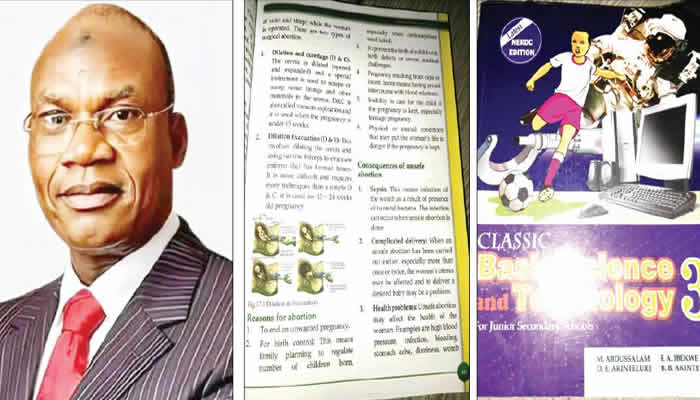
A viral post on X, formerly known as Twitter, has ignited widespread debate among Nigerians regarding the content of a Junior Secondary School Three (JSS3) science textbook.
The book, *Classic Basic Science and Technology for Junior Secondary School Three*, provides detailed descriptions of abortion procedures, types, reasons, and family planning.
One section on page 135 explains surgical abortion, describing two methods: Dilation and Curettage (D&C) and Dilation and Evacuation (D&E). It outlines the D&C procedure, used for pregnancies under 15 weeks, and the D&E method, employed for pregnancies between 15 and 24 weeks.
The controversy began when X user, Alex Onyia, shared the book’s cover and page on abortion, calling the content inappropriate for students. Onyia expressed concern, stating, “This book is teaching JSS1 students in Nigerian schools how to do abortions with clear images. Parents, wake up and save your children. NERDC approved this!”
The book, authored by M. Abdussalam, F.A. Ibekwe, D.E. Akintelure, and B.B. Akintelure, is published by Thursmay Publishers and bears the approval stamp of the Nigerian Educational Research and Development Council (NERDC). NERDC is responsible for reviewing and approving school textbooks to ensure alignment with national curricula.
In addition to the abortion content, the textbook addresses the consequences of unsafe abortions and other related topics. Onyia’s post sparked a mix of reactions on X, with some users criticizing the inclusion of such material for young students, while others defended it.
One user, Johnson @Carrotsuite, expressed strong disapproval, claiming the content promotes a harmful agenda and could influence students to view abortion in a positive light. Another user, Ogwu Ikechukwu, countered this argument, suggesting that teenage students should be educated on the realities of teenage pregnancy and abortion.
Tosin Brown also supported the inclusion of the topic, stating, “An average JSS3 student is between 13 and 16 years old. There’s nothing wrong with this information for a teenager. We need to teach them properly, or the world will misinform them.”
Similarly, Benjamin Chukwudum, who supported Brown, emphasized the need for such education, saying, “This information is very appropriate for that age group. In three years, these young people will be adults, and this knowledge will help them navigate life.”
The debate continues, with some advocating for educational transparency on sensitive topics, while others push for a review of what is deemed appropriate for young learners.

