
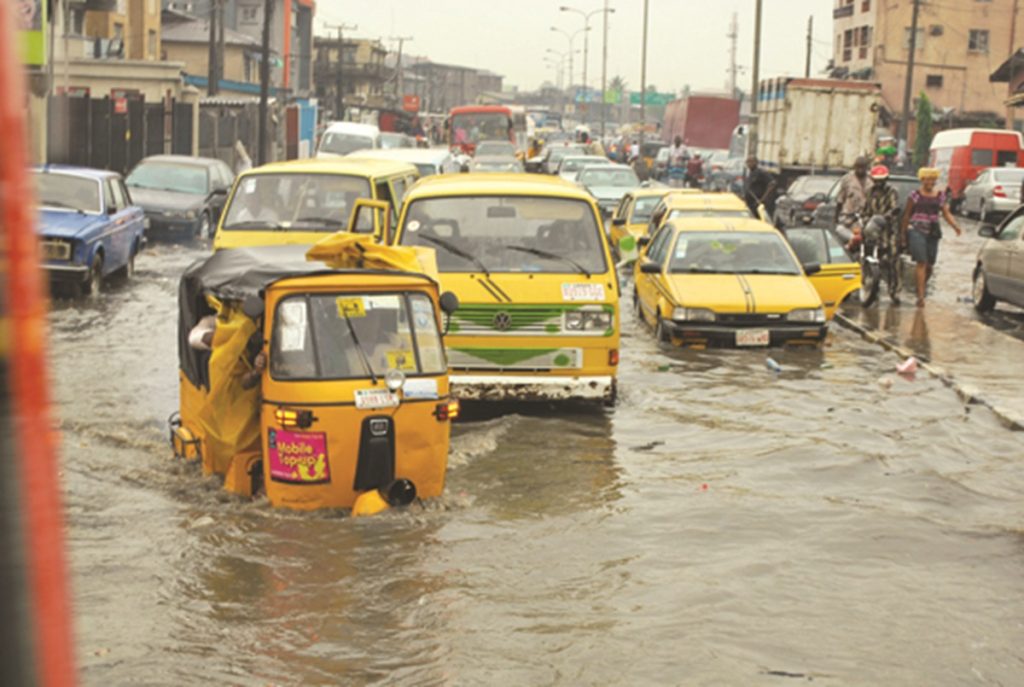
A severe downpour on Wednesday led to extensive flooding and significant traffic congestion across Lagos State, severely disrupting economic activities and daily life.
Numerous areas, including Iyana-Oworo, Oshodi, Ajah, Lekki, Ikeja, Egbeda, and Gbagada, were heavily affected, with roads submerged and almost impassable. The resulting gridlock caused discomfort and frustration among commuters, prompting many to voice their concerns and share updates on social media.
Chu Osakwe, an X user, posted a video showing the flooded area and advised, “This is Gbagada to 7up inward 3MB. Stay home if you have no business on the island. #Traffic.”
Another user, **Mochievous**, highlighted the severity of the situation near the Third Mainland Bridge, stating, “If your route this morning is mainland to the island via 3MB, just forget it. Turn back home or reroute. I just passed by on the opposite side and the beginning of Third Mainland (Iyana Oworo) is car door height flooded. I’ve never seen that on the bridge before.”
Mochievous further advised residents, “Please let me adjust my advice. If you live in Lagos, do not even consider coming out of your house today. Everywhere is flooded. I didn’t expect it to be this bad on the mainland. Flooded and all the roads were blocked in any direction.”
Lagos State Commissioner for Environment and Water Resources, **Tokunbo Wahab**, responded to the flooding concerns, particularly near the Third Mainland Bridge. He explained that the flooding in Olopo Meji inward 3rd Mainland was a flash flood resulting from the high intensity and prolonged duration of the rain, coupled with high tidal lagoon levels.
Wahab assured the public that the floodwaters would subside within 1-2 hours as the lagoon’s tidal levels decreased, allowing the rain and stormwater to discharge into the lagoon. In a statement on X, he said, “The Olopo Meji inward 3rd Mainland situation is a flash flood due to the high intensity and long duration of the rain, coupled with high tidal lagoon levels at the moment. Rest assured, it will subside in about 1-2 hours. As the high tidal level of the lagoon decreases, the rain and stormwater will be able to discharge into the lagoon.”
The heavy rainfall and resulting flooding have highlighted the need for improved drainage and flood management systems in Lagos State. While government officials are addressing the immediate concerns, long-term solutions are essential to prevent such disruptions in the future.

