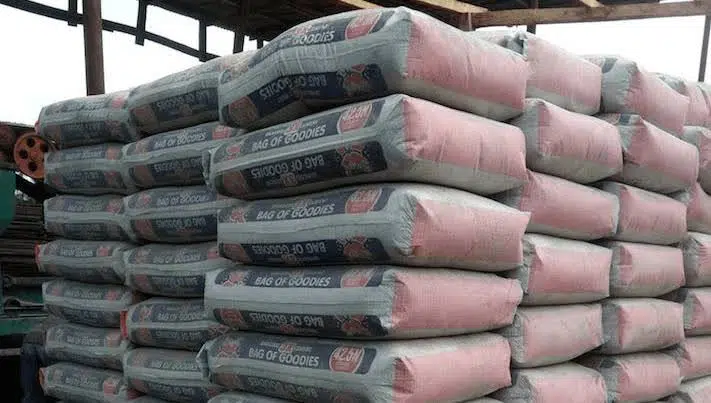
Nigerians may be facing another round of economic hardship following a fresh increase in the prices of cement produced by major manufacturers, including Dangote Cement and Mangal, with the hike reported across several parts of the country.
The price of a 50-kilogramme bag of cement reportedly rose to as high as ₦10,500 in January 2026, up from about ₦9,800 in December 2025. This reflects an increase of roughly ₦1,000 per bag, representing a 7.1 per cent rise within one month.
The adjusted prices have already taken effect in Abuja, Nasarawa, Niger and several other states, with variations attributed to location and transportation costs. The development has continued to raise concerns among Nigerians, particularly against the backdrop of the country’s abundant limestone deposits and other raw materials used for cement production in areas such as Obajana in Kogi State, Okpella in Edo State, and other mining hubs.
The latest price increase has also occurred despite earlier assurances by key stakeholders in the cement industry that prices would not exceed ₦7,000 per bag. Industry players warn that the rising cost of cement could further aggravate Nigeria’s housing crisis, placing home ownership and rental accommodation increasingly beyond the reach of average earners.
Findings show that the minimum annual rent for self-contained apartments has increased by more than 100 per cent to about ₦800,000 from roughly ₦400,000, particularly in major urban centres such as Abuja and Lagos. Despite the sharp rise in rents and construction costs, there has been no concrete intervention from the Federal Government, even as the overall cost of living continues to climb.
In December 2025, Nigeria’s inflation rate rose to 15.15 per cent, compared to 14.45 per cent recorded in November, adding further pressure to household finances and business operations.
Reacting to the development, a former President of the Real Estate Developers Association of Nigeria, Alhaji Aliyu Oroji Wamakko, expressed concern over the continued increase in cement prices, warning that the trend poses a serious threat to property development and employment across the country. He said higher cement prices would inevitably drive up the cost of housing and rents, while forcing some businesses within the construction value chain to shut down.
“Well, to tell you the truth, we are not happy with this development because first, the implication is a rise in the price of property development in the country,” he said. “Secondly, even the rent of apartments will go up, and it will also increase the loss of jobs by other people because this can call for other people to close their business because they cannot afford to go on with this.”
Wamakko recalled that last year, cement manufacturers such as Dangote and BUA were summoned by the Presidency after prices rose to about ₦10,000 per bag. According to him, the companies had promised at the time to reduce prices to around ₦7,000 per bag.
“If you remember last year, some of these cement production companies, like BUA and Dangote, were invited by the presidency when the cement jumped to ₦10,000, and they promised to bring it down to ₦7,000,” he said.
He noted that the reasons behind the latest increase remain unclear, adding that the government has so far remained silent on the issue. “So for now, we don’t know what happens or why the increase, and the government has kept quiet. Nobody said anything,” he added.
The former REDAN president also lamented the apparent inactivity of the Price Control Board, which he said should be monitoring and regulating sharp increases in essential building materials. “We suggested at that time there should be a price control board, which is in existence; at least they should be doing their work. Unfortunately, nobody said anything for now,” he said.
He warned that the situation has become increasingly unpredictable, making it difficult to determine how high cement prices could climb. Wamakko attributed the surge to several factors, including rising demand driven by extensive road construction projects where cement is being used in place of other materials, as well as foreign exchange volatility and Nigeria’s reliance on imported equipment and chemical inputs for cement production.
“Probably because of the road construction, they are now using cement instead of other materials, and that brings high demand,” he said. “Secondly, possibly because of the fluctuation of currency in the market. Most of the needed equipment and some chemical materials used for cement production are imported.”
He called for a comprehensive review of the cement production and pricing system to identify the root causes of the recurring increases and develop sustainable solutions. “Together, we felt that there must be a complete checkup within the system to find out what the problem is and how we solve it,” Wamakko concluded.