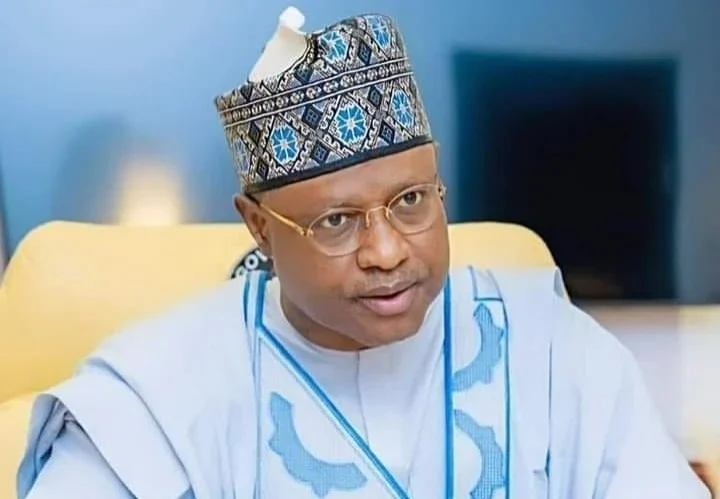
The outgoing Executive Chairman of the Kaduna State Internal Revenue Service, Jerry Adams, has attributed the sustained growth in the state’s Internally Generated Revenue to Governor Uba Sani’s political will and non-interference in the operations of the agency.
Adams, who spoke at the ongoing 160th meeting of the Joint Revenue Board in Kaduna on Thursday, said the state’s IGR had risen from N58 billion before 2023 to N85 billion in 2025.
He said the revenue had continued to increase and that Kaduna was now trending towards an annual collection of N120 billion, with an average monthly revenue of N10 billion.
“The IGR of Kaduna State stood at N58bn before 2023. By 2023, it had risen to N62bn and, in 2024, it reached N71bn.
“In 2025, we recorded an annual revenue of N85bn, with an average monthly collection of N7bn. Today, we are trending towards N120bn, at a monthly average of N10bn,” he said.
According to Adams, the growth was not a temporary spike but a steady and sustainable trend that would be strengthened through deeper collaboration with ministries, departments and agencies, stakeholders and the state government.
He recalled that between 2019 and 2023, the highest annual revenue collection recorded by the service was N59 billion in 2022, representing an average monthly collection of about N4.8 billion.
Adams, however, said a closer examination of the figures showed that a significant portion of the revenue came from back-duty recoveries, the sale of government properties and other one-off recoveries rather than organic growth in the state’s tax base.
“On paper, that looked like progress. But if you looked closer, as we eventually did, you’d find out that a significant portion of that revenue didn’t come from organic tax growth.
“It came from back-duty recoveries, sale of government properties and some other one-off recoveries, not a growing, breathing tax base,” he said.
He said the model eventually stalled by early 2023, prompting the agency to rethink its revenue strategy.
Adams said KADIRS subsequently shifted its focus from merely increasing collections from existing taxpayers to expanding the tax net and bringing more businesses and individuals into the tax system.
“We could no longer keep squeezing the same familiar taxpayers a little harder each year and call it strategy.
“We needed to grow horizontally, not just vertically; to expand the tax net itself, rather than simply tighten it around those already caught in it, and to stop relying on windfalls to flatter our numbers,” he said.
The outgoing chairman said the agency also embarked on the full digitisation of its processes to block revenue leakages through the introduction of the PAYKADUNA portal and Project C.R.A.F.T., an initiative aimed at improving revenue administration and fiscal transparency.
“This gave us, for the first time, a centralised payment system for all state revenue, closing gaps that informal, cash-based collection had long allowed to thrive,” he said.
Adams said KADIRS also recruited additional personnel to expand its tax coverage, provided working tools for staff and facilitated the promotion of workers whose advancement had been delayed.
He added that the agency provided capacity-building opportunities for its personnel and established three additional area offices to complement the existing 34 offices across the state.
The former KADIRS chairman said the service also strengthened collaboration with institutions including the Joint Revenue Board, the Nigeria Revenue Service and the Nigerian Financial Intelligence Unit, particularly in data sharing.
According to him, the partnerships had helped the state identify taxable activities that previously went undetected.
Adams, who is the All Progressives Congress governorship running mate for the 2027 election, also attributed the improvement in tax compliance to increased trust between taxpayers and the government.
He disclosed that tax compliance in the state had risen from about 30 per cent to approximately 65 per cent.
“Tax compliance is a function of trust. When we began, compliance across the state stood at a modest 30 per cent. Today, I am pleased to report that the compliance level has risen to approximately 65 per cent,” he said.
Adams stressed that the improved revenue performance should not be seen as the achievement of KADIRS alone but as a broader governance success involving the state government, taxpayers, ministries, departments and agencies and other stakeholders.