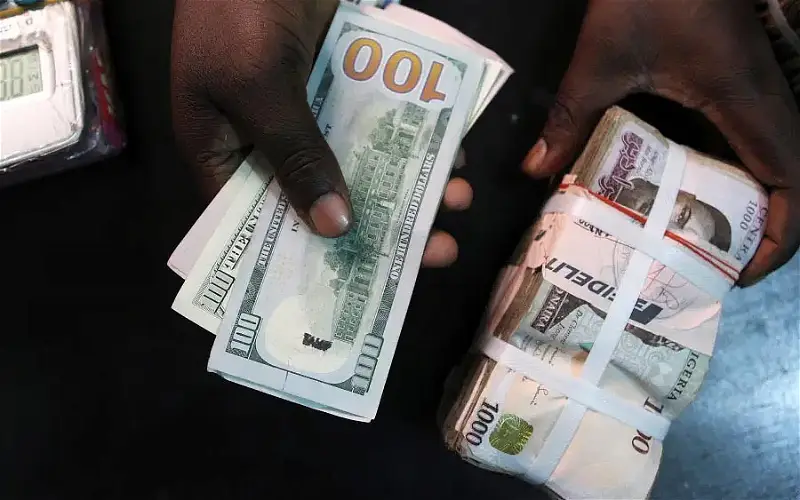
The naira strengthened to N1,350 per dollar on August 17, 2026, recording its strongest closing level since April 22 as the currency extended its recent gains against the US dollar at the Nigerian Foreign Exchange Market (NFEM).
Foreign exchange data published by the Central Bank of Nigeria (CBN) showed that the naira appreciated from N1,358.25/$ on August 14 to N1,350/$ on August 17, representing a gain of N8.25 or about 0.6 per cent.
The latest appreciation extends the naira’s recent strengthening trend, with the currency moving from N1,368/$ at the end of July to N1,350/$ by August 17.
The August 17 closing rate was the strongest recorded since April 22, when the naira closed at N1,348.10/$.
Data from the NFEM showed that the naira traded between N1,347 and N1,361 per dollar during Monday’s session.
The weighted average exchange rate stood at N1,349.54/$, while the simple average was N1,350.98/$.
The latest closing rate was stronger than the N1,358.25/$ recorded on August 14 and N1,356.50/$ on August 13.
From N1,368/$ on July 31, the naira has appreciated by about 1.3 per cent against the dollar by August 17.
The session recorded 178 interbank deals, with interbank turnover estimated at $437.53 million.
The latest movement points to continued relative stability in the official foreign exchange market, with the naira trading within a narrower range compared with some of the wider fluctuations witnessed earlier in the year.
The naira’s recent performance has also come against the backdrop of movements in global currency markets, where the US dollar has traded near multi-month lows against several major currencies.
The weakness in the dollar has been linked to changing expectations around US monetary policy following softer economic indicators, including weaker retail sales and job market data.
The euro traded at about $1.1581 in early Asian trading, close to the two-month high of $1.1614 recorded on Monday.
Sterling stood at about $1.3548, near its three-month peak, while the Australian dollar gained 0.11 per cent to $0.71119. The New Zealand dollar traded at around $0.5902.
Investors have reduced expectations of near-term US monetary tightening following weaker economic indicators and relatively mild inflation readings.
While global currency movements provide an external backdrop to the naira’s recent gains, domestic foreign exchange conditions remain critical to the direction of the Nigerian currency.
The latest appreciation also comes as Nigeria’s headline inflation rate declined to 15.43 per cent in July 2026 from 15.91 per cent in June, according to the National Bureau of Statistics.
The July inflation figure represented a 0.48 percentage-point decline from the previous month, while month-on-month headline inflation eased to 1.57 per cent in July from 1.66 per cent in June.
Meanwhile, activity in the official foreign exchange market has fluctuated in recent weeks.
On August 11, NFEM turnover fell to $185 million, its lowest level in 11 weeks, as market activity weakened.
The number of deals dropped to 186 on Tuesday from 348 on Monday, while interbank deals declined from 182 to 47.
Market activity, however, improved the following day, with 409 deals recorded and NFEM turnover rising to $607.47 million.
The naira’s recent strengthening also coincides with an improvement in Nigeria’s external reserve position.
Nigeria’s external reserves rose to $52.02 billion on July 20, 2026, their highest level since January 2009 and above the CBN’s projected full-year level for 2026.
The CBN had projected in December that the country’s external reserves would rise to $51.04 billion in 2026, supported by stronger oil earnings, foreign exchange market reforms and improved external inflows.
The continued appreciation of the naira at the official market, combined with stronger external reserves and easing headline inflation, points to improved conditions in some areas of Nigeria’s macroeconomic environment, although pressure on food prices and other cost-of-living challenges remains.