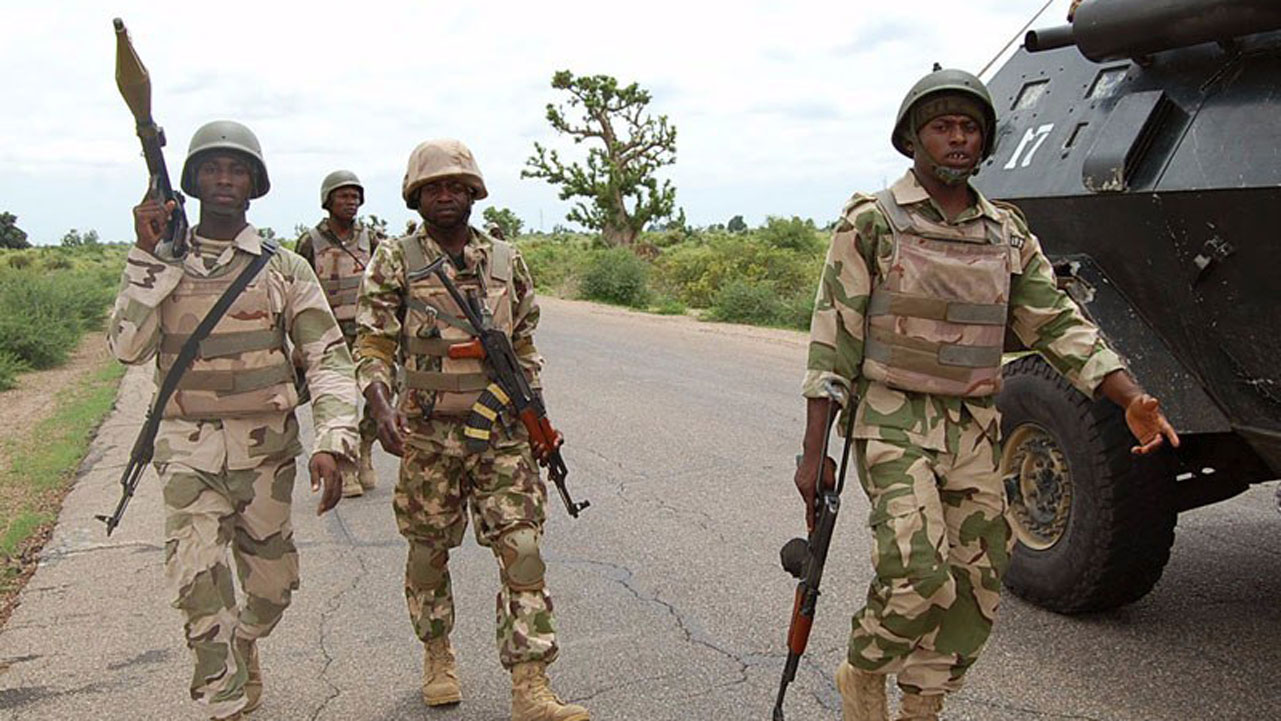
Nigeria’s security forces have recorded significant gains in the fight against terrorism, banditry, kidnapping and other violent crimes following intensified coordinated operations led by the Armed Forces in collaboration with other security agencies under the Office of the National Security Adviser (ONSA).
Recent operations conducted across the North-East, North-West, North-Central, South-South and South-East have resulted in the dismantling of terrorist camps, the elimination of notorious criminal leaders, the rescue of kidnapped victims, the disruption of logistics networks and the arrest of suspected collaborators, signalling renewed momentum in the country’s ongoing security campaign.
At the centre of the coordinated security drive is the Office of the National Security Adviser, headed by Mallam Nuhu Ribadu, which has continued to synchronise intelligence gathering and joint operations involving the Nigerian Armed Forces, the Department of State Services (DSS), the Nigeria Police Force, the National Intelligence Agency (NIA), the Nigeria Security and Civil Defence Corps (NSCDC) and other security agencies.
One of the most notable breakthroughs came with the successful rescue of pupils and teachers abducted from Oriire Local Government Area of Oyo State after spending 56 days in captivity. The victims were freed following an intelligence-led operation coordinated by ONSA and the National Counter Terrorism Centre and executed by more than 10 security agencies led by the General Officer Commanding 2 Division of the Nigerian Army.
Security operatives reportedly combed forests around the Old Oyo National Park, dismantled kidnappers’ camps, arrested suspected members of the criminal network, including informants and logistics suppliers, and secured the release of all the victims without casualties.
President Bola Tinubu described the operation as a major victory in the fight against insecurity, commending the military, intelligence agencies and the police for their professionalism. Eight suspects were arrested during the operation, while several terrorists linked to the kidnapping were neutralised.
The Defence Headquarters also reported that troops conducted coordinated operations between July 3 and July 9, during which 129 kidnapped victims were rescued, terrorist camps destroyed, weapons recovered and several terrorists and other criminal elements neutralised.
Director of Defence Media Operations, Major General Michael Onoja, said the military sustained offensive operations that disrupted terrorist logistics, dismantled criminal infrastructure, intercepted arms traffickers and protected critical national assets across various theatres of operation.
In the North-East, troops of Operation Hadin Kai rescued six abducted farmers in Borno State while destroying several logistics bases and support structures belonging to Islamic State West Africa Province (ISWAP) and Jama’atu Ahlis Sunna Lidda’awati wal-Jihad (JAS) terrorists in Ngala Local Government Area.
Security forces also arrested a suspected terrorist informant accused of identifying wealthy individuals for kidnapping and intercepted logistics suppliers transporting construction materials, motorcycle tyres, solar panels and other items allegedly destined for terrorist enclaves. Family members of suspected terrorists also surrendered in separate operations.
In another major breakthrough, troops intercepted a suspected foreign terrorist logistics courier. A 48-year-old Chadian national was arrested while allegedly transporting cannabis, toxic chemicals, alcoholic beverages and other prohibited substances believed to be intended for terrorist camps around the Lake Chad region.
Military authorities said the seized items were commonly used to sustain terrorist operations and embolden fighters, describing the arrest as a significant disruption of terrorist supply chains.
Operations under Operation Fansan Yamma also intensified across Kaduna, Katsina, Zamfara and Kebbi states, where troops carried out fighting patrols, ambushes and intelligence-led raids. Large quantities of arms, ammunition, motorcycles and materials suspected to be used in the production of Improvised Explosive Devices (IEDs) were recovered, while several suspected informants and logistics suppliers were arrested.
The military also disclosed that the Nigerian Air Force thwarted a planned terrorist offensive after tracking a convoy of nearly 300 armed terrorists travelling on motorcycles towards communities in Zamfara and Katsina states. Precision air strikes reportedly dispersed the convoy and inflicted heavy casualties on the fleeing terrorists.
In a separate operation, troops neutralised Alhaji Tukur, identified as a notorious bandit commander and younger brother of wanted kingpin Alhaji Shehu Bagiwaye, further weakening criminal networks operating in the North-West.
In the North-Central, troops operating under Operations Savannah Shield, Enduring Peace and Whirl Stroke recorded additional successes, including the neutralisation of a notorious terrorist leader known as Puuga in Benue State. Security forces also dismantled arms trafficking networks, arrested suspected kidnappers and rescued several abducted victims.
Among those rescued were Mrs. Lydia Odegba, the 72-year-old mother-in-law of the Chairman of Katsina-Ala Local Government Area, a pregnant woman who escaped from captivity following sustained military pressure, and two farmers who regained their freedom after fleeing from their abductors. Troops also recovered 249 rustled cattle from the camp of a neutralised terrorist leader.
In the South-South, troops of Operation Delta Safe rescued 37 traders and boat crew abducted by sea pirates along the Oron-Ibaka waterways in Akwa Ibom State after engaging the criminals in a gun battle. Joint operations involving the DSS also led to the arrest of suspected kidnap kingpin Saidu Mohammed and another gang member in Edo State.
The military also intensified its crackdown on crude oil theft by dismantling illegal refining sites in Rivers State and recovering more than 205,000 litres of stolen crude oil and illegally refined petroleum products.
In the South-East, troops of Operation Udo Ka raided criminal hideouts in Imo and Enugu states, recovering firearms, military camouflage uniforms and other items allegedly used by criminals to impersonate security personnel. A large illegal oil bunkering site containing about 70 refining pits was also destroyed in Abia State.
Beyond military operations, law enforcement agencies have stepped up efforts against kidnapping syndicates. The Federal Capital Territory Police Command recently dismantled a suspected kidnapping and “one chance” robbery syndicate linked to the abduction of a young woman in Maitama, during which ₦8.8 million was reportedly collected as ransom. The suspects, including the alleged gang leader, Ifeoma Nnamchi, were arrested in Suleja, Niger State.
Although security authorities have yet to officially confirm reports circulating on social media regarding the arrest of relatives of some terrorist suspects, security analysts say the sustained disruption of logistics networks and coordinated intelligence operations have significantly weakened terrorist and bandit groups across the country.
The renewed offensive has also received backing from the Federal Government. President Tinubu recently convened a high-level security meeting at the Presidential Villa involving the National Security Adviser, service chiefs, intelligence chiefs and senior security officials to review ongoing operations and reinforce strategies aimed at sustaining pressure on criminal elements nationwide.
While acknowledging that insecurity remains a major national challenge, recent operational successes suggest that Nigeria’s security agencies are increasingly adopting a more coordinated, intelligence-driven and technology-supported approach to confronting terrorism, banditry and kidnapping.
The rescue of the Oriire pupils and teachers, the destruction of terrorist camps, the dismantling of logistics networks, the elimination of criminal commanders and the rescue of more than 100 kidnapped victims within one week have strengthened public confidence that sustained collaboration among security agencies can further degrade the operational capacity of violent criminal groups and improve security across the country.