
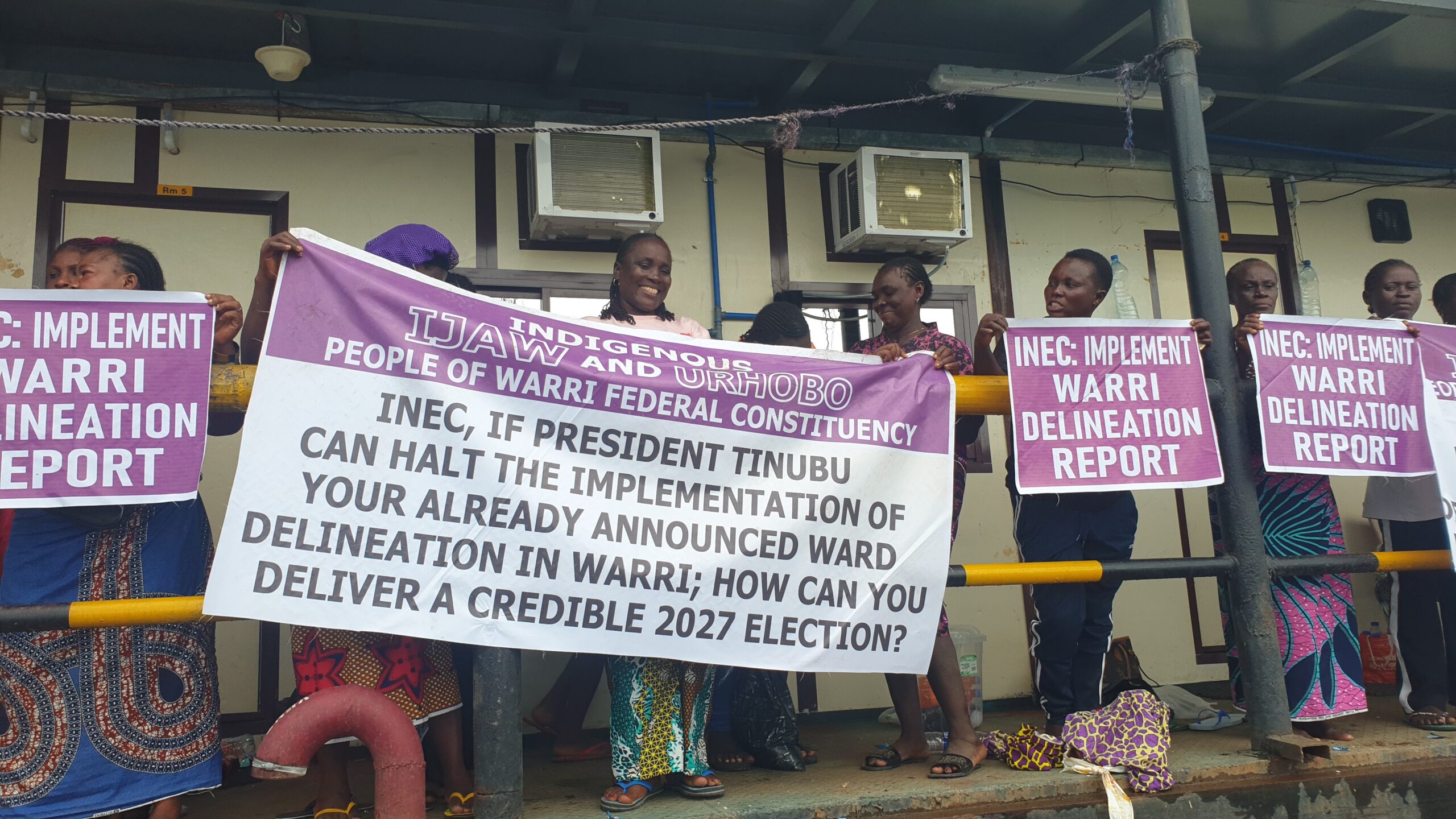
A major disruption has hit Nigeria’s oil sector as hundreds of indigenous women, youths and community leaders from Ijaw communities in Delta State launched a coordinated protest on Monday, leading to the shutdown of several key oil and gas facilities across the Warri Federal Constituency.
The protesters vowed that production would not resume until the Independent National Electoral Commission (INEC) implements its constituency delineation report for the area.
The peaceful occupation affected critical oil infrastructure operated by Chevron Nigeria, including the Kenyagbene (Abiteye), Otunana, Jones Creek, Odidi 1 and 2, Batan, Ogbanabou, and Egwa 1 and 2 flow stations.
The action adds a significant economic dimension to the ongoing dispute surrounding the Warri Federal Constituency ward delineation report released by Independent National Electoral Commission in May 2026.
Carrying placards bearing messages such as “INEC: Implement Warri Delineation Report,” “Court Ordered Judgment on Wards and Polling Units Delineation,” and “No Implementation, No Production,” the demonstrators accused the electoral commission of delaying the implementation of a report it had already presented to stakeholders in Asaba on May 20, 2026.
For the host communities, the protest represents a struggle for political representation and recognition. Community leaders argued that areas responsible for a substantial share of Nigeria’s oil and gas production should not continue to experience what they described as political marginalisation.
Speaking at the Kenyagbene (Abiteye) Flow Station, community women leader Chief Dr. Marian Ebike A. Ogoba said the protest was rooted in a Supreme Court directive that led to the boundary delineation exercise.
“We are here because of the boundary delineation that INEC conducted following a Supreme Court directive,” Ogoba said.
“As the hosts of the oil and gas wealth driving Nigeria, we refuse to accept continued marginalization. We are not looking for a fight; we are simply claiming our legal rights. These facilities will remain shut down until INEC complies with the apex court’s orders.”
Another community leader and immediate past secretary of Benekukru Community, Madam Fanty Goodness Owotorufa, stressed that the communities remained committed to peaceful protest but insisted that implementation of the report could no longer be delayed.
“The Supreme Court has already ruled on how these wards should be structured. The only thing left is for INEC to implement its own approved and published report. We are peaceful people, but we demand justice,” Owotorufa stated.
The dispute traces its roots to a 2022 judgment by the Supreme Court of Nigeria, which ordered a comprehensive review of electoral boundaries within the Warri Federal Constituency. Following the ruling, INEC conducted the delineation exercise, received objections from stakeholders, addressed complaints and prepared a final framework.
A former secretary of Benikrukru Community and opinion leader, Dr. Paul Boyitie, questioned why the commission had yet to formally implement the outcome of the exercise ahead of preparations for the 2027 general elections.
“The final report clearly maps out the wards for the Ijaw, Urhobo, and Itsekiri populations. All objections were heard, and the blueprint was finalized. Why the delay?” Boyitie asked.
“We want to enter the 2027 general elections under this newly approved structure. We have the leverage to freeze operations on our lands, and we will stay here until INEC acts.”
The shutdown was also enforced at the Otunana Flow Station, where community representatives maintained that operations would remain suspended indefinitely.
Representing the Krukrudagbene Community, Edith Odafe said the action was directly linked to the delay in implementing the wards and state constituency structure presented by INEC earlier in May.
“The process was smooth, and the results were handed to us. Now, we want execution. The station is closed, and it stays closed,” Odafe said.
Community delegate Mrs. Gladys Kele also reiterated that the protest was focused on securing what the communities believe are their legitimate political rights.
“We don’t want conflict, but no one should strip us of our allocated wards. We will camp here until our rights are secured,” Kele stated.
The development comes amid heightened tensions over the implementation of the Warri constituency delineation exercise, a matter that has generated reactions from Ijaw, Urhobo and Itsekiri stakeholders. With several strategic oil facilities affected, attention is now focused on how quickly the electoral commission and relevant authorities can address the dispute and restore operations in one of Nigeria’s key oil-producing areas.

