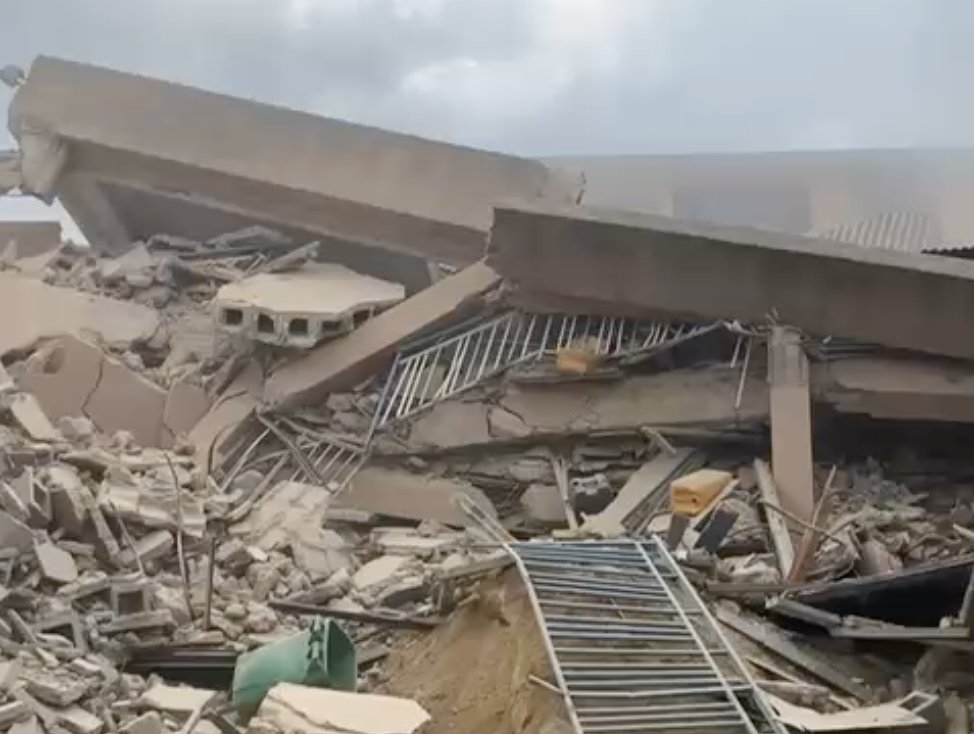
Hundreds of pupils and teachers narrowly escaped death in the Ogba area of Lagos State on Monday, March 9, after a building housing a school collapsed minutes after an emergency evacuation triggered by signs of structural failure.
The incident occurred at Yemco Nursery, Primary and Comprehensive College, located at 11 Adudatu Street in the Aguda axis of Ogba. According to reports, a resident who noticed distress signals in the structure raised the alarm, prompting school authorities to quickly evacuate pupils and staff from the premises.
The building collapsed around midday, barely three minutes after the children and teachers vacated the structure. The swift response ensured that no casualties were recorded in the incident.
An elderly man was said to have alerted the school authorities after noticing that the building had begun to show visible signs of structural failure.
“At first, the house started cracking little by little. The window frames had already fallen apart. After some minutes, the cement body of the house began peeling off. Not long after that, the building just sank,” a source said.
Officials of the Lagos State Fire and Rescue Service later arrived at the scene to secure the area and prevent further risks.
The near-tragedy has renewed concerns over gaps in building inspection and regulatory enforcement in Lagos, where agencies responsible for monitoring construction activities have repeatedly faced criticism over alleged lapses in oversight. The Lagos State Building Control Agency (LASBCA), the Lagos State Physical Planning Permit Authority (LASPPPA), and related institutions are tasked with enforcing building regulations and ensuring compliance with approved standards.
Building collapse has remained a recurring challenge in Lagos despite multiple regulatory reforms introduced over the years to address the problem.
Data compiled in previous investigations showed that Lagos accounts for more than 55 per cent of all recorded building collapse incidents in Nigeria since 1974. Between October 1974 and January 2025, at least 640 cases were documented nationwide, with more than half occurring within the state.
Investigations into these incidents have consistently linked the collapses to weak enforcement of building regulations, corruption within oversight agencies, non-compliance with approved safety standards, and the use of substandard construction materials.
Several building collapses recorded in 2025 further highlighted the persistent risks. In April 2025, a three-storey building housing the Equal Rights Restaurant and Bar collapsed in the Ojodu-Berger area during business hours, killing two people and injuring more than 20 others.
In May 2025, a two-storey building under construction in the Idi-Araba area of Mushin collapsed in the early hours of the day, resulting in the death of one labourer while three others narrowly escaped. Residents described the structure as a disaster waiting to happen before the incident occurred.
Later the same month, tragedy struck the Ota-Ona community in Ikorodu when a two-storey uncompleted building collapsed and killed three members of the same family — 16-year-old Maleek, his 13-year-old sister Ameerah, and their uncle Bolaji.
Another incident was recorded in September 2025 in the Yaba district of Lagos when a three-storey building under construction collapsed, killing one person and leaving several others injured.
One of the deadliest building collapse incidents in the state occurred in 2021 when a 21-storey luxury high-rise building under construction in Ikoyi collapsed, killing 46 people, including the developer, Femi Osibona. Investigations later revealed that the structure exceeded the number of floors originally approved by regulators.
More recently, in February 2026, reports also highlighted the deteriorating condition of several police barracks in the Ikeja area, raising additional concerns about structural safety and regulatory oversight in the state.
In response to the recurring building collapse incidents, the Lagos State Government introduced several reforms aimed at strengthening inspection and enforcement mechanisms within the construction sector.
In March 2025, Governor Babajide Sanwo-Olu launched the Certified Accreditors Programme (CAP), a policy initiative designed to involve private sector professionals in the building inspection process. The programme emerged from recommendations made by a 2021 advisory panel established after a series of building collapse incidents in the state.
Under the CAP framework, accredited professionals are permitted to review building project drawings, monitor different stages of construction, and report illegal or non-compliant structures while working alongside regulatory authorities.
The initiative was introduced as part of broader efforts to strengthen compliance with building safety standards and improve regulatory oversight of construction activities across the state.
The Lagos State Government also announced that enforcement operations had been intensified and that collaboration among agencies responsible for physical planning, building control, and regulatory compliance had been strengthened.
Sanwo-Olu’s Chief Press Secretary, Gboyega Akosile, said the state government remained committed to ensuring strict adherence to building regulations and would continue to penalise individuals or organisations found violating the law.
Despite these initiatives, experts have warned that the persistence of building collapses indicates deeper structural issues within the regulatory system. They argue that without sustained political will, transparent enforcement mechanisms, and stronger public accountability, Lagos could continue to experience preventable building disasters.