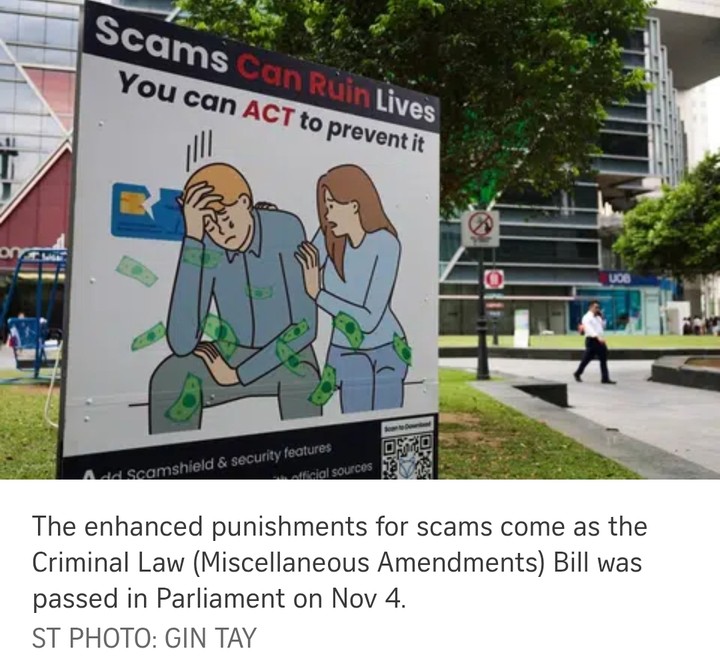
Singapore has passed sweeping new criminal law amendments introducing mandatory caning for scammers, syndicate recruiters, and their accomplices, following staggering financial losses of almost $4 billion to fraud schemes since 2020.
The new measures were approved in Parliament on November 4 under the Criminal Law (Miscellaneous Amendments) Bill, marking one of the country’s toughest crackdowns on financial and cyber-related crime in recent years.
Under the new law, offenders convicted of scam-related crimes will receive at least six strokes of the cane, with penalties rising to 24 strokes for the most severe offences. Members of syndicates and recruiters will also be subject to caning, while money mules—those who provide bank accounts, SIM cards, or Singpass credentials to criminal networks—will face up to 12 strokes. The penalties are designed to deter individuals from aiding fraud operations that have cost thousands of Singaporeans their life savings.
During the Bill’s second reading, Senior Minister of State for Home Affairs Sim Ann emphasized that scams have become the most prevalent form of crime in Singapore, accounting for 60 percent of all reported offences. Between 2020 and mid-2025, more than 190,000 scam cases were reported, resulting in losses estimated at $3.7 billion. “These are staggering numbers… The losses are more than three and a half times the cost of building Woodlands Health Campus,” she said. Police figures revealed an additional $187.1 million lost between July and September 2025, bringing the total to approximately $3.88 billion since 2020.
The decision to introduce corporal punishment for scammers followed a parliamentary debate in March, when Jurong GRC MP Tan Wu Meng raised the issue during the Home Affairs budget session. He shared the case of a resident who lost her entire life savings to scammers and questioned whether Singapore’s laws were too lenient. On November 4, Sim Ann confirmed that the ministry had reviewed his proposal and agreed that caning would serve as a strong deterrent.
Beyond scams, the new legislation introduces discretionary caning for traditional forms of fraud and several other changes to modernize Singapore’s criminal code. The amendments also recalibrate caning for other crimes—removing the punishment for eight lesser offences under the Railways Act, such as blocking carriages or endangering passenger safety—on the basis that societal conditions have evolved. Sim clarified that this does not reflect leniency but a rebalancing of punishment to ensure proportionality, adding that serious sexual and violent offences will continue to attract caning.
The Bill also introduces tougher penalties for sexual offences, particularly for those who distribute obscene materials. Offenders who circulate such content to ten or more people can now face up to two years in prison, while those sharing content involving minors face up to four years. The move comes in response to cases like the notorious SG Nasi Lemak Telegram group, where over 44,000 members exchanged explicit images of women and girls. “We cannot begin to imagine the distress suffered by a young girl whose images are sent to thousands of prying eyes,” Sim said, stressing that such content often remains permanently online, compounding victims’ trauma.
The new provisions extend to administrators of online platforms or chat groups that facilitate obscene material sharing, as well as those who exploit artificial intelligence to generate sexually explicit content or deepfakes. The amendments make it clear that producing or distributing any intimate image without consent—real or AI-generated—constitutes an offence. Singapore’s laws will now also classify realistic computer-generated depictions of minors as child sexual abuse material, aligning the country’s standards with United Nations conventions by extending protection to all individuals below 18.
Further reforms address sexual grooming across borders, with offenders facing up to seven years in jail if the victim is under 14, or five years if aged 14 to 17, provided there is evidence of exploitation.
Another key provision increases the penalty for fatal abuse of vulnerable persons, with offenders now facing up to 30 years’ imprisonment or life imprisonment, compared to the previous maximum of 20 years. Sim cited the 2016 case of a couple who fatally scalded their five-year-old son, noting that the Court of Appeal had upheld life imprisonment as appropriate and that the government agreed with the ruling.
Other amendments target doxing of public servants, introducing a new offence for spreading falsehoods alongside personal information, punishable by up to three years in prison and fines of $10,000. Additionally, stricter sentencing options are now available for youth offenders aged 16 and 17, allowing courts to impose imprisonment, reformative training, or caning when cases are heard in higher courts rather than youth courts.
To aid law enforcement, regulatory changes now require workers and dealers in precious metals to wait five days—up from three—before altering or melting down items, giving police more time to trace stolen goods and pursue offenders.
Eleven Members of Parliament debated the Bill in a session lasting over two hours. Jurong Central MP Xie Yao Quan urged that punishments for scams be made comparable to those for drug offences, arguing that scammers inflict equivalent social and economic harm. “I would stop short of calling for capital punishment for the most egregious scammers,” he said. Meanwhile, Workers’ Party MP Sylvia Lim questioned whether caning effectively deters crime but admitted having little sympathy for scammers due to the devastating material and psychological impact on victims. She also sought clarification on cross-border cooperation against scam networks, particularly with Cambodia, which has become a regional hub for cybercrime. Sim replied that although Cambodia is not part of the Frontier+ anti-scam collaboration platform, bilateral cooperation remains effective.
Tanjong Pagar GRC MP Foo Cexiang recounted a personal incident in which a family member narrowly avoided being defrauded by a scammer impersonating an official from the Monetary Authority of Singapore. The scammer had manipulated her into isolating herself for hours while transferring funds, until relatives intervened in time. Foo called for stiffer penalties for government impersonation scams, warning that such acts erode public trust.
Responding to lawmakers, Sim Ann emphasized that deterrence is only one aspect of the government’s anti-scam strategy. She highlighted Singapore’s whole-of-society approach, combining law enforcement, technological measures, and public education to reduce scam vulnerability. “The message is clear,” she said. “If you enable scams, even indirectly, you will face the full force of the law.”
The amendments mark a significant escalation in Singapore’s battle against online and financial crime, reinforcing the country’s reputation for zero tolerance toward offences that threaten public trust and economic security.