
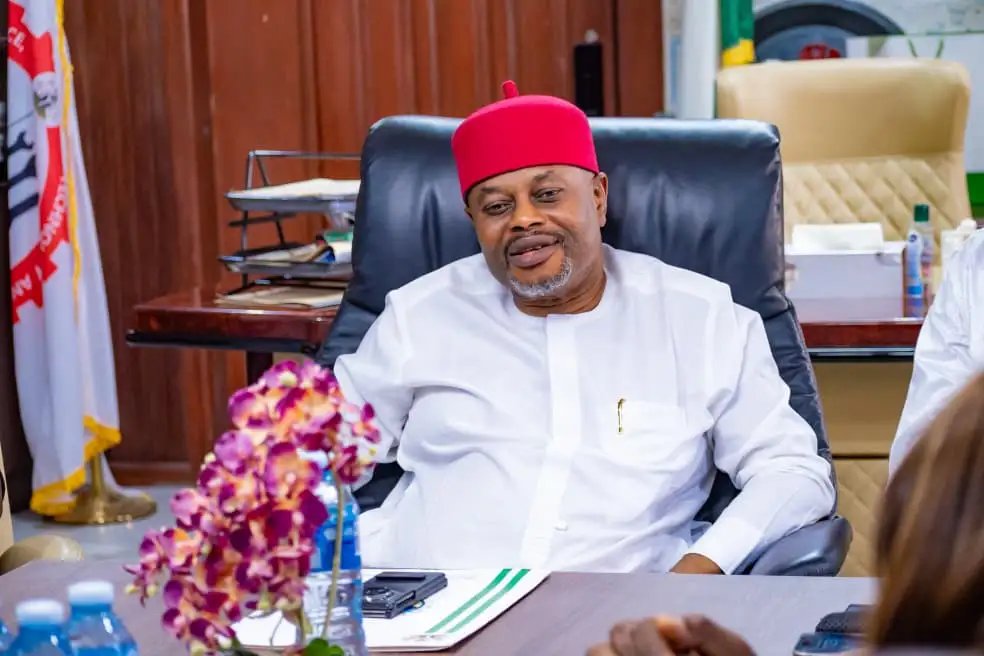
In a story that underscores the intense scrutiny placed on public officials, Nigeria’s Minister of Innovation, Science and Technology, Geoffrey Uche Nnaji, resigned on October 7, 2025.
His departure was the culmination of a two-year controversy over the authenticity of his university degree—a fundamental requirement for holding a ministerial position.
For anyone new to the story, here is a step-by-step breakdown of how the issue started and escalated.
The Foundation: A Ministerial Nomination
The saga began in July 2023 when President Bola Tinubu named Geoffrey Nnaji among his first batch of ministerial nominees. To be appointed a Minister in Nigeria, the Constitution requires that a person be “educated up to at least School Certificate level or its equivalent.” In practice, this is interpreted as possessing a minimum of a university degree.
Almost immediately after his name was announced, critics and media outlets raised red flags. They questioned the validity of the Bachelor of Science degree in Microbiology/Biochemistry from the University of Nigeria, Nsukka (UNN), which Nnaji had presented, as well as the authenticity of his National Youth Service Corps (NYSC) discharge certificate.
Despite these allegations, the Senate confirmed his appointment, and he was sworn in as Minister in August 2023.
The Turning Point: The University Steps In
For nearly two years, the allegations simmered in the background. The situation reached a critical point recently when the university at the center of the storm, UNN, broke its silence.
In response to a formal request from PREMIUM TIMES newspaper, the Vice-Chancellor of UNN, Professor Simon Ortuanya, issued a definitive statement. He confirmed that while Mr. Nnaji was admitted to the university in 1981, the institution had no record that he ever completed his studies or graduated. This directly contradicted the certificate Nnaji had presented to the public and the Senate.
This official disowning of the degree by the very institution that was supposed to have issued it transformed the allegations from mere speculation into a serious credibility crisis.
The Smoking Gun: The Minister’s Own Admission
As public pressure mounted, the most damning evidence emerged not from journalists, but from the minister himself, contained in court documents.
Mr. Nnaji had taken the university and other educational bodies to court. In an affidavit he personally signed and filed at the Federal High Court in Abuja, he made a stunning admission. In paragraph 13 of the document, he stated, “That even though I am yet to collect my certificate from the [University of Nigeria]…”
This statement confirmed the core allegation: he had never received a degree certificate from UNN. This created an irreconcilable conflict: how could he present himself as a graduate if he had never collected—and by the university’s account, was never issued—a certificate?
To make matters more complex, an earlier letter from the UNN Registrar in December 2023 had affirmed Nnaji’s graduation. However, the university later declared this letter to be invalid, stating it was issued in error and that a thorough check of the 1985 graduation records confirmed Nnaji’s name was absent.
The Inevitable Conclusion: Resignation
Faced with an incontrovertible fact—his own admission in a legal document—and the university’s official position, Mr. Nnaji’s position became untenable. The scandal dominated news cycles and undermined his authority to lead a ministry dedicated to science and technology.
On October 7, 2025, he submitted his resignation letter to President Tinubu. In it, he thanked the President for the opportunity to serve but claimed he was a victim of “blackmail by political opponents.” President Tinubu accepted the resignation, thanking Nnaji for his service.
In essence, the minister resigned because he could not prove he held the basic educational qualification required for his job, a fact ultimately established by his own submission to a court of law. The case highlights the critical importance of credential verification and accountability in public service.

